Showing posts with label project management. Show all posts

Friday, March 17, 2017

Project Program and Portfolio Management

Even though the PMI ACP is focused at managing projects the agile way, as a project manager we would still need to know the difference between a Project, Program and a Portfolio to be able to do our jobs better. Most people have a misconception that they are one and the same. Hopefully by the end of this article you would understand that they are not the same. 

In the Series on PMP Exam Prep, I had published an article titled “Relationship between Project, Program and Portfolio” which you should visit to understand more details as I wont be covering the exam same details once again here. Click here

What is Project Management? 

According to the PMBOK – Project Management is the application of Knowledge, Skills, Tools and Techniques to Project Activities to meet the Project Requirements. 

Project management aims to converts the abstract concept or vision the organization has to reality.

Trivia: Remember the Trivia from the Previous Article on Project Life cycle? Even though every project goes through the 5 life cycle stages as per project management standards, the number of steps or phases in an actual industry project need not have the exact same 5 stages/phases. You need to keep this difference in mind when answering Questions. 

WHY DO PROJECT MANAGERS NEED SOFT SKILLS?

The Project Manager is someone who is responsible for multiple things in the project and spends most of his time communicating with the rest of the project team members. The project wouldn't have even a remote chance of success if the Project Manager is unable to build relationships with his superiors, peers, end users, sponsors and every other stakeholder of the Project. 

Some of the common Management and Interpersonal skills a PM needs include: 
  • Leadership – Leadership skills refer to developing a strategic plan and motivating team members to achieve their objectives. Leadership and management skills help project managers to realize successful project completion
  • Motivation – Motivational skills involve energizing people to achieve high levels of performance and overcome barriers to change
  • Problem Management – Problem solving skills involve the combination of problem definition, alternatives identification and analysis, and decision making
  • Conflict Resolution – Conflict management skills refer to conferring with others to enable an agreement to be reached
  • Negotiation – Negotiation skills refer to the implementation of a give-and-take policy whereby parties involved are happy with the outcome of the deal and a win–win situation results
  • Communication Skills – One of the most important skills of a project manager is effective communication. Effective communication involves exchanging proper information to meet the objective of communication and ensure smooth relations with team members. Merely conveying your want is not enough: You need to communicate in such a manner that you get the desired response out of the person with whom you are interacting. Effective communication is, thus, a two-way process.
  • Etc. 

Yes, the PM needs Project Management Skills but he also needs a ton of Soft Skills to be successful. There will be an entire section/set of articles on soft skills so lets not waste too much time here and move on to Program Management. 

PROGRAM MANAGEMENT

According to the PMBOK, a program is a group of projects managed in a coordinated way to obtain benefits and control that would not have been obtained had the projects been managed separately. 

Program management focuses on project interdependencies and helps to determine the optimal approach for effectively managing them. An example of a program would be a new communications satellite system program, comprising projects for designing the satellite, constructing and integrating the individual systems, and launching the satellite.

In the exam, you may be given an example program and asked to identify possible projects associated with that program. So understand programs and projects and the relationship between them. A project may or may not be part of a program. A program will always have projects.

PORTFOLIO MANAGEMENT

By portfolio, we refer to a collection of projects or programs that have been grouped together to facilitate effective management to meet strategic business objectives.

Portfolio management refers to the selection process based on the need, profitability, and affordability of the proposed projects. The projects or programs that belong to a portfolio may not necessarily be interdependent or directly related. Portfolio management also refers to the centralized management of one or more portfolios, as detailed in the following section.

To understand how these 3 are related, look at the table below: 


Exam Tip: The distinction & relationship between Projects, Programs and Portfolios is provided more from helping you understand the bigger picture rather than from an exam perspective. The ACP exam only tests your ability to manage a small agile project. Program, portfolio related topics will not be in the exam. 

Now that we know the difference between a Project, a Program and a Portfolio, am also going to cover a small topic here. 


The primary function of a project management office (PMO) is to support project managers in the company in a variety of ways. They provide Coaching & Mentoring to the Project Managers and ensure consistency in the project management practices in the organization. In the PMP Exam series, I had written a detailed article about the Role of the PMO. I would suggest you revisit the article to learn more about what the PMO does in an Organization. 

Prev: Project Life Cycle

Next: Project Stakeholders


Monday, January 9, 2012

Lesson No. 1: Get Users Involved As Early As Possible


Imagine the Scenario – You have just completed an IT Project for a customer and when you deliver it to them, they arent satisfied. They feel it isnt exactly what they expected. Can you guess what went wrong?

The Manager probably collected the Requirements and then lost touch with the users or customers.

The secret to project success is to involve the users almost as soon as there is anything visible to show them. How much better it is to find out that there are problems with what we are developing early on, rather than after the project is complete!
Remember the PMP topics on Controlling Project Costs & Quality? Changes done to a project that is nearing its completion are far costlier than the ones that are taken up at earlier stages of the project.

Costs for changes become increasingly high the further along we are on the project schedule timeline. The time to recode, retest, and rework the immediate software, as well as to test integration with all the peripheral code involved, can delay the project substantially. And both time and cost baselines are jeopardized if a change is so major that it has to go through a lengthy Change Control Board process for approval.

As a project manager, you should get the users talking to the software developers early and often. This is exactly the reason why successful IT Projects have a team of Business Analysts who provide the interface between the users and the project team. They frequently interact with both parties and ensure that the expectations of both the team and the end users are met.

So, Hard Wire this in your brain – “Always involve Users & Customers as soon as possible in the Project Lifecycle and keep them involved throughout the life of the Project”

Index: Things a Good Project Manager Must Know

Friday, December 9, 2011

Project Execution

The following are the important themes you must remember from the PMI Perspective regarding the Project Execution Phase.

1. The project manager is ultimately responsible for the Project Execution
2. The Project Manager is ultimately responsible for the quality of the project.
3. The project team should solve its own problems and resolve its own issues whenever possible.
4. Team development occurs throughout the entire project lifecycle.
5. The five types of power that are available to a project manager are legitimate, coercive, reward, expert, and referent. Coercive or Punishment power should be used rarely and should never be used in public. If you are punishing someone for bad behavior or performance, make sure it is one on one in your cabin and not in a public place
6. The five conflict-resolution techniques are confronting (preferred method), compromising, withdrawal, smoothing, and forcing.
7. The performance evaluation process of an individual should include everyone who has had significant interaction with that individual.
8. Maslow's Hierarchy of Needs, in order, is physical, safety and security, social, self-esteem, and self-actualization.
9. Herzberg's Hygiene Theory suggests that pay is not as motivating as work satisfaction, learning new skills, and promotions, and it suggests that relationships only prevent job dissatisfaction; they do not motivate.
10. A McGregor Theory X Manager micromanages his team’s work and does not trust them. A Theory Y Manager trusts his team and expects them to be responsible for their work and motivates them to be successful.

Other PMI Themes:

General PMI Themes
Project Framework
Project Initiation
Project Planning
Project Monitoring & Controlling
Project Closure
Ethics & Professional Responsibility


Tuesday, August 2, 2011

PMP Exam Nuggets - Introduction to Project Management

Defining What a Project Is—and Is Not
o Projects are temporary, unique, and create a product or service.

o Projects move from concept to completion through progressive elaboration.

o Not all projects get selected. The decisions to choose one project over another may vary from organization to organization. The process, however, may be called project portfolio management.

o Projects have a definite beginning, middle, and ending; operations do not.

o Project management offices standardize the project management approach within an organization.
Defining Project Management
o Within the project management framework are nine knowledge areas, which span the project management life cycle.

o The focus of project integration management is managing all of the interactions of project components, processes, and knowledge areas.

o The focus of project scope management is on protecting, fulfilling, and delivering the project scope.

o The focus of project time management is on scheduling activities, monitoring the project schedule, and working with the project team and stakeholders to ensure the project completes on time.

o The focus of project cost management is on estimating and maintaining project costs.

o The focus of project quality management is on setting the quality expectations and then delivering the project product with the expected level of quality.

o The focus of project human resources management is on developing the project team to work together to deliver the project as expected.

o The focus of project communications management is on delivering needed information to the correct parties at the correct time. Much of project communications is on keeping the stakeholder informed of the project issues, risk, progress, and overall performance.

o The focus of project risk management is on identifying, mitigating, and managing project risks.

o The focus of project procurement management is soliciting, selecting, and managing vendors to complete project work or supply project materials.
Examining Related Areas of Project Management
o Projects often operate under the auspices of a PMO or a program. A program is a collection of projects working together for a common goal.

o A project manager must have multiple skills to be successful, including the ability to communicate, manage a budget, be organized, negotiate, and provide leadership for the project.

o Project managers in different sectors of business and nonprofit entities will encounter situations unique to their area of expertise. For example, a project manager of a construction project will have different issues and concerns than a project manager of a manufacturing project.

o Project managers require organization, problem solving, communication, and leadership skills and management abilities.

Friday, July 15, 2011

Points to Remember: Introduction to Projects & Project Management

Introduction to Projects & Project Management

1. Knowledge, performance, and personal skills are the three areas that project managers focus on to get better at their jobs.
2. When you’re talking about things like the people in your organization, the market you compete in, your company’s risk tolerance, and standards that your company needs to meet (like government-imposed standards for any contractor bidding on a government project), you’re talking about Enterprise Environmental Factors.
3. A program is a collection of projects that should be managed together in order to achieve a specific goal or benefit to the company.
4. A portfolio is a collection of projects or programs.
5. A project gathers a team together to do work that’s temporary, creates a unique result, and is progressively elaborated.
6. An operation (or process) is work that’s done in a way that’s repeatable and ongoing, but is not a project.

Organizational Structure

1. Functional managers have all the power in a functional organization. Project managers have the power in a projectized organization.
2. If a question on the exam doesn’t state an organization type, assume it’s referring to a matrix organization. That means the PM is responsible for making budgets, assigning tasks to resources, and resolving conflicts.
3. Project coordinators and expediters don’t exist in a projectized organization.
4. A project expediter keeps track of project status only.
5. A project coordinator has some authority, and usually reports to someone higher up in the company. Neither role has as much power or authority as a real project manager, even though an expediter or coordinator may have “Project Manager” written on their business cards.

Project Management Knowledge Areas

There are a total of 9 Knowledge Areas as per the PMBOK Guide. They are:

Integration Management: Coordinating all of the work so that it happens correctly. Making sure changes are approved before they happen.
Scope Management: Figuring out what work needs to be done for your project. Making sure your end product has everything you said it would.
Time Management: Figuring out the time it will take to do your work and the order you need to do it in. Tracking your schedule and making sure everything gets done on time.
Quality Management: Making sure you work as efficiently as you can and don’t add defects into the product.
Cost Management: Knowing how much you’re able to invest in the project and making sure you spend it right.
Human Resource Management: Getting the people to work on the team and helping them stay motivated. Rewarding them for a job well done and resolving conflicts that come up
Communications Management: Making sure that everybody knows what they need to know to do their job right. Tracking how people talk to each other and dealing with misunderstandings or miscommunications if they happen.
Procurement Management: Finding contractors to help you do the work. Setting the ground rules for their relationships with your company.
Risk Management: Figuring out how to protect your project from anything that could happen to it. Dealing with the unexpected when it does happen.

Points to Remember - Other Topics:

Relationship Between Knowledge Areas & Process Groups
Project Integration Management
Project Scope Management
Project Time Management
Project Cost Management
Project Quality Management
Human Resource Management
Project Communication Management
Project Risk Management
Project Procurement Management
Ethics & Professional Responsibility

Wednesday, May 11, 2011

Chapter 26: Developing the Project Management Plan

In the previous chapter, we took a high level view of the importance of project planning and the inputs to the process of creating the project management plan. In this chapter, we are going to look at the exact process of developing the Project Management Plan.

So, lets get started!!!

Developing the Project Management Plan

Once the project has been initiated, it is time to do some planning. Project planning starts with the process of developing a project management plan, which defines, prepares, coordinates, and integrates all subsidiary plans, such as scope and risk management plans, into one big plan called the project management plan. The goal here is to develop a source of information that will work as a guideline for how the project will be planned, executed, controlled, and closed.
One reason why it is important to develop a project management plan is that not all projects need all the planning processes, and to the same degree. Therefore, the content of the project management plan will depend upon specific project that is being worked on. As the project goes through different stages, the project management plan may be updated and revised through the change control process.

Below are some issues that a Project Management Plan is expected to address.

1. Which project management processes will be used for this process, what the level of implementation for each of these processes will be, and what the inputs and tools and techniques for these processes are
2. How the changes will be monitored and controlled
3. What the needs and techniques for communication among the stakeholders are
4. How the project lifecycle looks, including the project phases if the project is a multiphase project
5. The lifecycle selected for the project at hand


Let us take a pictorial look at the process of creating the Project Management Plan.


As you can see, the Project charter, Enterprise Environmental Factors & Organizational Process assets along with the output of other planning processes are used as the input to this activity.

A project manager’s expertise is used extensively to process these and the project management plan is the output.

Depending upon the complexity of the project, the project management plan can be either a summary or a collection of subsidiary plans and components, which might include the following:

1. Standard plans from the project planning process group, such as the cost management plan, communication management plan, process scope management plan, and risk management plan.
2. Some necessary plans, which may not be generated by standard processes, such as a change management plan that describes how changes will be monitored and controlled.
3. Other components, such as the milestones list, resource calendar, and baselines for schedule, cost, and quality.

The process of developing the project management plan falls in the knowledge area of integration management because it coordinates the various processes and activities.

Now that the project management plan is ready, let us look into the details of one of the important parts of planning – Project Scope Management.

Prev: Introduction to Project Management

Next: Managing Scope

Friday, May 6, 2011

Summary - Introduction to Project Management Topics

Let us quickly summarize what we learnt in the previous chapters about the basics of Project Management:

• The activities inside an organization are generally organized into groups, which fall into two categories: operations and projects.
• Operations usually consist of ongoing routine work, whereas a project has a goal to generate a unique product, service, or result in a fixed time frame i.e.,, it has a planned beginning and a planned end.
• Organizations launch projects for different reasons, such as to meet a business or legal requirement or to take on an opportunity offered by the market.
• A project, like anything else in an organization, needs to be managed.
• Project management is the application of knowledge and skills to project activities in order to meet the project objectives.
• It involves performing a set of processes that constitute nine knowledge areas of project management:
      o Communication management
      o Cost management
      o Human resource management
      o Integration management
      o Procurement management
      o Quality management
      o Risk management
      o Scope management and
      o Time management.
• Each process is part of a knowledge area and has a membership in one of the five process groups:
      o Initiating
      o Planning
      o Executing
      o Monitoring & controlling and
      o Closing.
• The process groups represent different stages of a project lifecycle.
• Each project has a set of individuals or organizations that it influences positively or negatively, and these individuals and organizations are accordingly called positive and negative stakeholders.
• Some of these stakeholders may influence the project. Therefore, you must identify all the project stakeholders, positive and negative.
• The different project stakeholders might have different and conflicting expectations, which you as the project manager need to analyze and manage.
• The project environment consists of elements such as organizational culture, organizational structure, enterprise environmental factors, and organizational process assets.
• The structure of the performing organization could be functional, projectized, or matrix.
• In a Functional Organization project managers don't have much authority whereas in a projectized organization, the project manager is king. And there is the matrix organization which can be a combination of either extremes.
• Some organizations have a composite structure, which is a hybrid of these three basic structures.
• A project can be standalone or part of a program, which is a collection of interrelated projects and possibly non-project work.
• A project can also be part of a portfolio, which is a collection of programs, projects, and other related work.


Previous: Big Picture of Project Management

Next: Important Terms & Definitions

Chapter 16: Project Management – The Big Picture

Well, in the previous many chapters, we have learnt a lot of basic fundamentals about Project Management, the project manager, scope, stakeholders etc etc. It would be inappropriate if we don't look at the project management as one big picture to make things clear to you.

So, lets get started!!!

The Big Picture of Project Management:

Let me start off by saying that, you might already be aware of the concepts covered in this chapter because, we have been doing that in the past many chapters. The purpose of this chapter is to give you a holistic view of how things fit in terms of project management.
Look at the picture below:


There are a total of 9 important aspects of a project and each of these aspects are managed by a different knowledge area. Remember the Project Management Knowledge Areas chapter?
Similarly, every project has 5 stages and each has its own significance. Remember the Project Lifecycle chapter?

The purpose of project management is to take care of these 9 aspects and carry out the project through these 5 stages effectively and successfully. So, project management is performed by applying processes from certain knowledge areas at certain stages of the project.

The three most important things we need to understand about Projects are::
• The project lifecycle consists of five stages, technically called process groups: initiating, planning, executing, monitoring/controlling, and closing. These process groups can be mapped to commonly known project stages: starting, organizing and preparing, carrying out the work, and closing.
• The project processes that are performed to manage projects constitute nine project management knowledge areas: communication management, cost management, human resource management, integration management, procurement management, quality management, risk management, scope management, and time management.
• A project is performed in a project environment that is shaped by many elements, such as organizational culture, organizational structure, enterprise environmental factors, organizational process assets, and the maturity of the organization.

I am really glad to say that we have covered one major chunk of the 1st part of our study related to Project Initiation. We will just summarize what we learnt in the next chapter and move on to the second part which will deal with the actual project initiation.

Previous: Project Management Office

Next: Summary of Topics on Introduction to Project Management

Chapter 15: Project Management Office - PMO

Every project has a project manager and every company that executes these projects has a Project Management Office (Mostly). In this chapter, we are going to learn about the project management office.

So, lets get started!!!

What is the Project Management Office?

The project management office (PMO) refers to an entity in an organization that is responsible for providing centralized & coordinated management and support for all the projects executed in the organization. The projects supported by the PMO may or may not be related to one another. The functions of the PMO depend upon the organization and its culture.

In general, a PMO is an interface between the business objectives of the organization and the projects. For example, depending on the organization, it may act as a stakeholder in projects and a key decision maker in the beginning of any project in order to ensure that the projects consistently support the business objectives of the organization. It may also be involved in selecting, prioritizing, allocating, and managing the project resources.

Simply put, the PMO can be considered as the office that manages all the project managers in the company.

The primary function of the PMO is to support project managers in multiple ways.
They include:
• Coaching - Provide coaching, training, mentoring, and oversight.
• Uniformity and consistency in standards :
      o Identify and develop management methodology, best practices, and standards for the projects.
      o Develop and manage procedures, policies, templates, and other documentation shared by the projects.
      o Audit projects to ensure the compliance of standards, policies, procedures, and templates.
• Resource management - Manage shared resources across all the projects administered by the PMO.
• Communication - Coordinate communication across projects.
To understand the relationship between the roles of a project manager and the PMO, remember the following three things:
• Scope - A project manager focuses on the objectives of the project, whereas the PMO manages the scope at the program level and handles scope changes at the program level that may be seen as potential opportunities to meet the strategic business objectives of the organization.
• Resources - The project manager controls and manages the project resources to best meet the project objectives, whereas the PMO works to optimize the use of project resources across all the projects.
• Project aspects - The project manager handles aspects such as cost, quality, risk, and schedule specific to the individual project he/she manages, whereas the PMO manages the interdependencies among the projects and the organization-level standards, such as project management methodologies, policies, and procedures.


Previous: Other Terms Related to Project Management

Next: Big Picture of Project Management

Chapter 13: Relationship between Project, Program, and Portfolio

So far, we have been talking in terms of projects only. There are two other terms that are closed linked with projects and project management. They are: Program and Portfolio. In this chapter, we are going to look at how these 3 entities are related.

So, lets get started!!!

Relationship between Project, Program and Portfolio:

As a project manager, you should know the basic concepts of program and portfolio and how they are related to each other and to projects. A program may be a part of a higher-level program; it certainly contains some interrelated projects, and it may contain some non-project work as well. Program management focuses on optimally managing the interdependencies among the various projects in the program. The person who manages a program is called the Program Manager.
The program manager’s responsibilities are:

• Prioritize to resolve resource conflict and constraints that affect multiple projects within his program.
• Keep your priorities aligned with the strategic goals and objectives of the organization.
• Resolve issues and manage change within the governance structure of the organization.

Just like a project is managed by a project manager, a program is managed by a program manager, who oversees the projects and provides high-level guidance to the project managers. In other words, a program manager oversees projects and coordinates efforts between projects but does not manage the projects.

Why is that?

That is because; we the project managers are managing our projects!!!

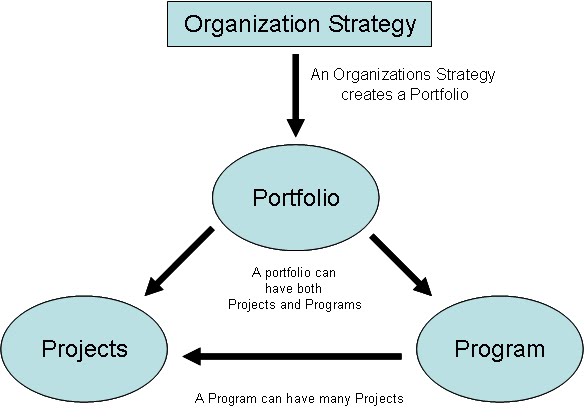
A portfolio contains both programs and projects and is managed by a portfolio manager. The portfolio is drawn directly from the strategic business plan of the organization.
The strategy of an organization is an action plan to achieve its business goals and objectives. It’s also called a strategic plan or a strategic business plan. The strategy determines the portfolio of projects and programs that the organization will execute. A portfolio is a set of projects, programs, or both that is managed in a coordinated fashion to obtain control and benefits not available from managing them individually.

What is Portfolio Management?

Portfolio management is the centralized management of one or more portfolios, and it includes identifying, prioritizing, authorizing, managing, and controlling projects, programs, and other related work in order to obtain specific strategic business objectives of the organization. Just as a program is managed by a program manager, a portfolio is managed by a portfolio manager.
To understand the relationship between these 3 entities, projects, programs and portfolios we need to understand that:

• If an organization does not have any programs but has only individual projects, all these projects can be grouped into one or more portfolios.
• If an organization has programs and no individual project external to all programs, all these programs can be grouped into one or more portfolios.
• If an organization has some programs and some individual projects, all these programs and projects can be grouped into one or more portfolios.

Portfolio management focuses on making sure that programs and projects are prioritized for resources to serve the organization’s strategy. In simpler terms, a portfolio manager worries about the success of the whole strategy put forth by the organization rather than the success of a single project (like what we do)

Therefore, investment decisions are usually made at the portfolio level. Program management focuses on achieving the benefits that would be aligned with the portfolio and hence with the strategic objectives of the organization. So, a portfolio is part of the interface between the programs and strategic business objectives of the organization for which the programs are run.

The relationship between these 3 entities is better explained by the picture below:


As you can see in the picture above, a portfolio is composed of projects, programs or both. And a program consists only of projects.

When compared to projects and programs, a portfolio is closer to an organization’s business objectives, and therefore this is where most of the investment decisions are made.
It’s also important to note that an operation is not part of a project. However, a program can include a non-project work. Similarly, a portfolio can also include work that is not included in any of its constituent projects and programs.

Let us wrap up this chapter with a comparison between projects, programs and portfolios.

Comparison between a Project, a Program, and Portfolio


Previous: Environmental Factors & Process Assets

Next: Other Terms Related to Project Management

Wednesday, May 4, 2011

Chapter 8: Project Stakeholders

In the previous chapters, we have been using the term Project Stakeholders repeatedly and we havent had any clear cut definition or description as to who these people are. Well, you need to look no further, we are going to do it right away in this chapter.

So, lets get started!!!

Who are the Project Stakeholders?

Project stakeholders are individuals and organizations whose interests are affected (positively or negatively) by the project execution and completion. In other words, a project stakeholder has something to gain from the project or lose to the project. Accordingly, the stakeholders fall into two categories—positive stakeholders, who will normally benefit from the success of the project, and negative stakeholders, who see some form of disadvantage coming from the project. The implications obviously are that the positive stakeholders would like to see the project succeed and the negative stakeholder’s would be happy if the project was delayed or even better cancelled.

For ex: let us say, your state government wants to build a Government Hospital in your city. It is a good thing right? You, the citizens of your city and the chief minister are all positive stakeholders of this project. Lets say there is a private Hospital in the city that is having a thriving business currently. They would be negative stakeholders because, if the government hospital comes up, their business will be affected and hence they would be happy if the government scraps its project.

Negative stakeholders are often overlooked by the project manager and the project team, which increases the project risk. Ignoring positive or negative project stakeholders will have a damaging impact on the project. Therefore, it’s important that you, as the project manager, start identifying the project stakeholders early on in the project. The different project stakeholders can have different and conflicting expectations, which you need to analyze and manage.

Identifying Project Stakeholders

Identifying all the project stakeholders might be a difficult task, but the following are the obvious stakeholders in any project:

1. Project manager - Include yourself first. The project manager in charge of the project, in the list of the stakeholders to start with.
2. Project management office (PMO) - If your organization has a PMO, and it is directly or indirectly responsible for the outcome of a project, then the PMO is a stakeholder in that project.
3. Project team - This team consists of the project manager, the project management team, and the individuals who perform the work of the project to produce the project outcome. This team may consist of individuals from different groups and departments with different subject matter expertise and skills.
4. Program manager - If your project is part of a program, then the program manager is certainly a stakeholder of your project.
5. Portfolio managers - A portfolio manager is an individual who performs high-level management (governance) of a set of projects or programs and interfaces between the projects/programs and the business strategy of the organization for which the projects and programs are being run.
6. Portfolio review board - A portfolio review board is a committee that selects and rejects the projects by reviewing them for factors such as the project value, return on investment, and risks involved in performing the project.
7. Functional managers - These are the individuals who play the management roles within administrative or functional areas of the organization. For example, the VP of marketing is a functional manager and so is the director of engineering. The level of authority depends on their position in the hierarchy and also the organizational structure. For example, if you are using resources that are under a functional manager, that functional manager is a stakeholder of your project.
8. Operational management - These are the individuals who are performing management roles in the operational areas of the organization. For example, the director of IT, who is responsible for maintaining the computer network that your team is using, is a stakeholder in your project. Depending on your project, you might be handing over the product of the project to an operations group that will be responsible for providing the long-term support for it.
9. Sellers – Sellers are entities external to the performing organization, such as contractors and suppliers, who enter into a contractual agreement with the performing organization to provide certain components for the project. These components are the products, services, or results that you procure.
10. Business Partners - Business partners are the external organizations that fill a specific role for the project, such as installing the product of the project, providing training and support for the product, or providing specialized expertise for the project. Business partners are different from vendors in that they have a special ongoing relationship with the organization, which sometimes is attained by satisfying some requirements, such as certifications.
11. Customer/user - In general, customers are the entity that will acquire the project’s outcome, such as product, and users are the entity that will use the product. In some cases the customers and users may be the same entity, and in other cases there may be a whole chain (with different layers) of customers and users.
12. Project sponsor - This is the individual or group that provides financial resources for the project. A sponsor has a major stake in the project and may perform an active role in the project team from time to time.

Following are some of the functions of a sponsor:

1. The sponsor champions the project when it’s conceived. This includes gathering support for the project by performing actions such as acting as project spokesperson to the higher-level management and spelling out the benefits of the project.
2. The sponsor leads the project through the selection process until the project is finally authorized, at which point the leadership role goes to the project manager.
3. The sponsor plays an important role in developing the initial project scope and charter.
4. The sponsor serves as an authority and a catalyst for issues beyond the control of project managers, such as authorizing some critical changes and other yes/no decisions.

Identifying Other Stakeholders

We have just identified the easy bunch of stakeholders that every project would have. In addition to these key stakeholders, who are easy to identify, there can be a number of other stakeholders, who might be more difficult to identify, inside and outside your organization. Depending upon the project, these might include investors, sellers, contractors, family members of the project team members, government agencies, media outlets, lobbying organizations, individual citizens, and a whole myriad of other individuals who might have an interest in this project and its outcome.

While dealing with the stakeholders, the keyword is influence. Watch out for influencers who are not direct customers or users of the product or service that will come from the project, but who can influence the course of the project due to their position in the customer organization or the performing organization. The influence can be positive or negative.

So, not only are the stakeholders affected positively and negatively by the project, but the project can also be impacted positively or negatively by them. It is critical for the success of the project that you identify positive and negative stakeholders early on in the project, understand and analyze their varying and conflicting expectations, and manage those expectations throughout the project.

Trivia:

Do not confuse the project management team with the project team. The project management team consists of individuals involved in the project management tasks. It is a subset of the project team, which includes the members of the project management team and also other members, such as those who perform the actual work of the project.

In the next chapter, we shall take a look at one of the most important and influential stakeholder in any project. The person who can make or break the project.

Previous: Project Management Knowledge Areas

Next: The Most Influential Stakeholder

Chapter 5: Understanding a Process

In the previous chapter we learnt what progressive elaboration is. At the end of it, we saw that every project needs to follow a set of processes. In this chapter, we are going to understand them in detail.

So, lets get started!!!

What is a Process?

Processes are the heart of project management. If you want to think of project management like a project management professional, think in terms of processes. Almost everything in the world of project management is done through processes. Any good project manager respects and follows the processes properly. In the short term, skipping a process might sound like a time saving option but the reality is, following them would give you more benefits than the time you save by skipping them.

To understand more about processes, we must first define them. Look around you, you will see processes everywhere, not only in project management. For example, if you want to make an egg omlette, you first let the pan heat up in the stove, sprinkle a little oil on it, crack open the egg and beat it with salt and pepper in a bowl, add a little onions for taste and then pour the beat up egg in the pan. You let it cook for a minute and then flip it over until both sides are a golden brown. And voila, a tasty omlette is ready for you to eat.

Here, the pan is the tool and how you make the omlette is the process. The output is a plate of fresh egg omlettes for you to feast on.

So, a process is a set of interrelated activities performed to obtain a specified result.

Every process has 3 elements:

• Input
• Tools
• Techniques

In our case:

• Oil, salt, pepper, onions and egg are the inputs
• The frying pan and the stove are the tools
• The cooked omlette is the final output


This is just a real-life simple example of a process. You would be using so many processes in real life without even realizing the fact.

Processes in Project Management:

In project management, you use processes to accomplish things like developing a project schedule, directing and managing project execution, developing and managing the project team and so on…

From the project management perspective, the 3 elements of a process would be:

• Input - The input to a process consists of the raw data that is needed to start the process. For example, the list of activities that need to be scheduled is one of several input items to the process that will be used to develop the schedule of a project.
• Tools and techniques - Tools and techniques are the methods used to operate on the input to transform it into output. For example, project management software that helps to develop a schedule is a tool used in the schedule development process.
• Output - The output is the outcome or the result of a process. Each process contains at least one output item; otherwise, there would be no point in performing a process. For example, an output item of the schedule development process is, well, the project schedule.

Now that you understand what a process is, you likely realize that you will be using different processes at the different stages of a project, such as planning and execution.

Every project has a lifecyle and you will be using numerous processes as part of each of those stages in a projects lifecycle. This is what you will be learning in the next chapter…

Previous: Progressive Elaboration

Next: Project Lifecycle

Chapter 4: What is Progressive Elaboration

In the previous chapter, we understood in detail what a project is. In this chapter, we are going to see what Progressive Elaboration is.

So, lets get started!!!

What is Progressive Elaboration

Projects may be temporary endeavors but they cannot be conceived in a day and for sure cannot be executed/completed in a day (unless you define going to the grocery store as a project)
Usually there is a concept first and then a broad vision for the end product, i.e., the outcome or result of the project.

The clearer vision you have of the unique product that you want from the project, the more accurate the project plan will be. So, you move toward the final project plan in incremental steps as the ideas about the final product are refined and as you get more and more information about the requirements in a progressive fashion. This procedure of defining (or planning) a project is called progressive elaboration.

Example of Progressive Elaboration:

Let us imagine the following:

You are the Managing Director of Honda Motors and you wake up one fine day with an idea to reassert Honda as a leading car manufacturer. You intend on doing that by creating a super fast sports car that is going to give the Ferraris and the Lamborghinis a run for their money. How do you do it?

You first conceptualize your car, how you want it to look, how much you want to price it, the kind of speed you want it to reach, the kind of luxury & safety features you want in your car, the list is endless. Going back to the first line of this paragraph, you cannot list down the whole set of requirements in a day.

You first define a set of basic guidelines like:

I want my car to touch 300 kmph and not exceed $250,000. It must be one of the most luxurious drives a car aficionado can get his hands on. It must have top of the line safety features.

The next step would be to call for a meeting with your top designers and engineers and kick start the cycle. They will now take your basic guidelines and start building on it. Once all the requirements of your dream sports car is ready, you go to the next big step.

How are you going to do this?

Here you are referring to the project plan. By now, you could have understood that a project plan is a detailed step by step explanation of how you intend on completing a project. All the resources involved (men, money, time etc) will be taken into account and steps will be outlined that the people involved in the development of the project will follow to take the project to success.

What will be the Result?

A product, a super fast sports car that will take the markets by storm…

Progressive elaboration, in general, means developing something in incremental steps. The project plan will be broadly defined to start and will get more accurate, detailed, and explicit in an incremental fashion as better understanding about the project deliverables and objectives develops. It involves successive iterations of the planning process resulting in a more accurate and complete plan.

Even after you have an approved final project plan and the project starts executing, progressive elaboration continues to some extent.

Trivia:
Uncontrolled changes that make their way into the project without being properly processed are called scope creep. Do not confuse progressive elaboration with scope creep. And don't worry about scope creep just yet. We are just getting started. We will deal with this bad boy in detail very soon.

Each stage of a project is managed by performing a set of processes. And the process is what we will learn in the next chapter…

Previous: Understanding Projects

Next: Understanding Process

Chapter 3: Understanding Projects

Well, we have taken the first baby step towards getting our PMP Certification. In the previous chapter, we learnt what a Project is and many other important terms that are essential for us to know in our quest of the elusive PMP title.

In this chapter, we are going to get a better understanding of what a project is and what a project lifecycle is.

So, lets get started!!!

What makes Projects Different?

You might have been wondering, what makes projects different. From the previous chapter, we learnt that the project is a temporary endeavor to accomplish a defined task. You might ask me, any organization might have so many activities that are executed on a daily basis. What makes projects different?

The activities taken up by any organization fall into two distinct categories:
1. Projects &
2. Operations

An Operation is an ongoing and repetitive set of tasks like cleaning the washrooms daily, or maintenance of the power back up in the building once every month etc. It has no end (unless the company goes bust) whereas; a Project has a lifecycle, a beginning and a definite end.

Understanding a Project

A project is a work effort made over a finite period of time with a start and a finish to create a unique product or service or result. Because a project has a start and a finish, it is also called a temporary effort or endeavor. In other words, a project is a temporary endeavor taken to create a unique product, service or result. So, a project has two defining characteristics: It is temporary, and it creates a unique result.

Let’s try to understand these two defining concepts: temporary and unique.

Temporary - The temporary nature of projects refers to the fact that each project has a definite beginning and a definite end. A project can reach its end in one of two possible ways:
• The project has met its objectives—that is, the planned unique product has been created or the results achieved.
• The project has been terminated before its successful completion for whatever reason.
The temporary nature of projects can also apply to two other aspects:
• The opportunity to market the product that the project will produce is temporary—that is, the product needs to be produced in a limited timeframe; otherwise, it will be too late.
• A project team is temporary—that is, the project team is disbanded after the project ends, and the team members may be assigned to other projects eventually.
However, remember that the temporary nature of a project does not refer to the product it creates. The results or outcomes of a project are usually long lasting. Go back to the building your home example. Even though the construction process ends after say 9 months, your house is going to stand forever (Unless you plan on renovating or rebuilding it from scratch, which by themselves will be separate projects)

The second defining characteristic of a project is that it must create a unique product.

Unique product - The outcome of a project must be a unique product, service, or result.
How do these 3 terms differ from one another?
• Product - This is a tangible, quantifiable artifact that is either the end item or a component of outcome. The LCD TV in your living room or the fast BMW Car you drive or the nice diamond pendant you got your wife on her birthday are some examples of products.
• Service - Actually, when we say a project can create a service, we really mean the capability to perform a service. For example, a project that creates a website for a bank to offer online banking has created the capability for the bank to offer the online banking to its customers.
• Result. This is usually the knowledge related outcome of a project—for example, the results of an analysis performed in a research project.

We might use these 3 terms product or service or result interchangeably during the course of our study and remember that, though they might be 3 different things, from a project perspective, they all signify one thing – the project is completed successfully.

In the previous paragraph, we had seen the fact that projects are different from operations and we even saw a simple example. In order to manage projects efficiently you must first be able to identify if an activity is a Project or an Operation. To do that, you must be able to distinguish the two clearly.

Distinguishing a Project from an Operation

An organization executes a wide variety of activities as part of its work to achieve its business objectives. Some of these activities are to support projects and others are to support what are called operations. An operation is a set of tasks that does not qualify to be a project. In other words, an operation is a function that performs ongoing tasks: It does not produce a unique product and nor does it have a beginning or an end or both.

For example, Building your house is a project, whereas maintaining/cleaning it regularly is an operation.

It is important to understand that projects and operations share some characteristics, such as the following:
• Both require resources, including human resources (people).
• Both are constrained to limited, as opposed to unlimited, resources.
• Both are managed—that is, planned, executed, and controlled.
• Both have objectives.

The distinctions between projects and operations can be made by sticking to the definition of a project—that it is temporary and unique. Operations are generally ongoing and repetitive. Although both projects and operations have objectives, a project ends when its objectives are met, whereas an operation continues toward attaining a new set of objectives when the current set of objectives has been attained.

Go back to our example, building your house is a one time activity (Project) whereas, cleaning the house once every week to keep dirt and rodents away is a recurring activity (Operation) that has to be done every week, unless you intend on sharing your residence with rats and cockroaches!!!

Some Example Projects:

Projects can be performed at various levels of an organization; they vary in size, and accordingly can involve just one person or a team. Some examples are:

Project Project Outcome
Constructing Your House Product
Running an election campaign Results: win or lose; Products: documents
Developing a website to offer online banking Service
Setting up a new Office Service
Moving your office to a new building Result: office is moved
Study the genetic makeup of a new species of birds in a forest Results (of the research); Product: research paper
How do projects come into existence? In other words, how do you come up with a project? Sure, you have an idea, a concept of some final product, but how exactly do you write it down and declare it as a project? A project is born and brought up through a procedure called progressive elaboration. This is what we are going to learn in the next chapter!!!

Previous: Introduction to Projects

Next: What is Progressive Elaboration

Tuesday, May 3, 2011

Chapter 2: Introduction to Projects

Well, I am very excited to start writing this series of articles to help us prepare for the PMP Certification. We will be taking small steps one after the other and slowly reach our goal of the PMP certification. This is the first step in our pursuit.

So, lets get started!!!

What is a Project?

Anything and everything around us can be considered a project. For ex: building a nice home for you and your family is a project, same is the case if a government is trying to build a big power plant in your city. Irrespective of the size or the amount of money involved, both of them are projects.

What is common between these 2 examples? Your house and a power plant? Both involve, people, money and time. They both have a start and end and most importantly someone has to supervise the whole way to ensure that the project proceeds as planned and is completed on time and within budget.

The important point to note here is – someone has to supervise the whole way!!!

Yes, you read it right, any project has to be managed and controlled by an expert if it has to be a success. Failing which, the project will most probably be a failure.

Exam Trivia:
Miracles do happen. But, in terms of the PMP Exam, Miracles are like the UFOs. Everyone has a doubt, but no one will risk their life to prove their existence. Similarly, there might be a rare case where an ill managed project becomes successful, our goal is to manage a project properly and as per the guidelines laid down by the PMI Institute to ensure that the project we are managing is a Success.

Before we proceed any further, let me give you the technical definition of what a project is:

A project is a work effort made over a finite period of time with a start and a finish to create a unique product, service, or result. Because a project has a start and an end, it is also called a temporary effort or endeavor

The definition is simple, isnt it? Now recollect, building your house is a project. You start it with a Grihapravesham (The Initial Pooja’s you do before beginning the construction), then you identify a builder, start buying raw materials like cement, steel, bricks etc, and go step by step and at the end of 9 months, voila your new and beautiful house is ready.

Since, you will no longer be building your house after 9 months, it is a temporary Endeavour and has a finite end at the end of construction.

Now I guess you understand the definition :-)

What is meant by Managing a Project?

Managing a project means managing the lifecycle of the project, starting from the beginning (initiating) and going to the end (closing); this is accomplished using processes, which constitute what are called project management knowledge areas. Although you use your knowledge in terms of processes to manage the projects, the management will be greatly influenced by the environment in which the project runs, such as the structure and culture of the performing organization.

If you want a quick synopsis of the various stages in the life of Managing a Project, just go back to the previous chapter and read it…

Terms you need to understand to begin your preparation:

Well, we have started our preparation for the PMP Exam. In the course of this and subsequent articles, we will be using various important terms. Each has a meaning and purpose. Now, let us go through each of them one by one.

Exam Trivia:
All these terms are simple and very important. You need to understand them in order to make sense of the subsequent topics. So pay attention!!!

• Organization
An organization is a group of individuals organized to work for some purpose or mission. Computer companies, telephone companies (to whom you pay your phone bills), and cable companies are examples of organizations. An organization might offer products, such as books, or services, such as Internet access or online banking. A project is usually performed inside an organization. Organization is a very broad concept that includes groups for profit and nonprofit, public and private, and government and nongovernment.
• Project stakeholder
A project stakeholder is an individual or an organization that can be positively or negatively affected by the project execution. A project can have a wide array of stakeholders, like the project sponsor, the customer for whom you are executing the project, the end user who is going to use the system etc.
• Process
A process is a set of related tasks performed to manage a certain aspect of a project, such as cost or quality. Each process belongs to a knowledge area and corresponds to a process group. There are a bunch of set guidelines that can help you achieve a goal and they are usually termed as processes.
• Knowledge area
A knowledge area in project management is defined by its knowledge requirements related to managing a specific aspect of a project, such as cost, by using a set of processes. PMI recognizes a total of nine knowledge areas, such as cost management, human resource management etc.
• Performing organization
The performing organization is the organization that is performing the project.
• Project management
Project management is the usage of knowledge, skills, and tools to manage a project from start to finish with the goal of meeting the project requirements. It involves using the appropriate processes. Remember the Supervisor who is going to oversee your house construction
• Program
A program is a set of related projects managed in a coordinated fashion to improve overall efficiency and effectiveness and to obtain benefits and control that would not be obtained by managing them individually. For example, a program could be delivering a product (or service) that consists of sub-products (or service components) delivered by the constituent projects. Also, a program might include related work that is not included in the scope of any of the constituent projects.
• Program management
Program management is the centralized, coordinated management of a specific program to achieve its strategic goals, objectives, and benefits.
• Program management office (PMO)
The program management office is an entity in an organization that is responsible for providing centralized, coordinated support to the program managers managing programs and unrelated projects.
• Project management office
Project management office (PMO) refers to an entity in an organization that is responsible for providing centralized coordinated management and support for projects in the organization.

Exam Trivia:
Although both have the same abbreviation, PMO, the project management office and program management office are not identical. For example, only an organization that runs programs will have a program management office, whereas an organization that runs individual projects can have a project management office.


What is a Portfolio:

A portfolio is a set of projects, programs, and related work that is managed in a coordinated fashion to obtain business objectives in the strategic plan of the organization.
Portfolio management is the centralized management of one or more portfolios that includes identifying, authorizing, prioritizing, managing, and controlling projects, programs, and other related work in order to obtain specific business objectives in the strategic plan of the organization.

Now that we know the key terms that are required to continue our preparation, lets move on to the next topic…

Previous: Main parts in Managing a Project

Next: Understanding Projects

Sunday, May 1, 2011

Tips to get PMP Certified

Below are some tips I picked up from various books about taking the PMP Certification Exam.


1. PMI has a very formal way of naming processes, process groups, knowledge areas, and even documents. However, just like in real life, do not expect that the exam will always refer to these names in a formal way. Try to know both the formal and informal representation of each key term. To help you further, I will try to obtain both those terms and use them in this blog.

2. The questions in the PMP exam can be wordy and might include unnecessary information to distract you from the real question/information related to the real question. So, you need to read the questions carefully and patiently and figure out what is relevant and what is nonsense.

3. Get comfortable with the idea that there will be some questions that you will not be able to answer correctly. In such a situation, just believe in yourself and your experience, and select the answer you feel would be the nearest match. If you are still not sure, just leave it for now and proceed to the next one. you can always come back to review them if you have time in the end.

Remember - Dont get frustrated.

4. There will be tricky questions to weed out candidates who might have project management experience, but who do not have an in-depth understanding of the discipline of project management from the perspective of PMI. Make sure you are cautious and catch hold of such questions and answer them appropriately.

5. There will be questions for which you will need to choose between an innocent way of skipping the formal process to save time and following the formal project management process. In almost all cases, the correct answer will be to follow the process.

Remember - Never ignore the process, atleast from the certification point of view.

6. There will be questions for which you will need to choose between facing the problem head on or taking an easy way out, such as dodging a thorny issue, ignoring a challenging problem, or postponing a difficult decision. Almost always, the correct answer is to meet the problem head on in a professional manner.

Remember - Ignoring a problem today might cause the same one to magnify and it will for sure come back to haunt you at a later date. So it is always better to handle problems then and there

7. To answer some questions correctly, understand that in the world of project management as seen from the perspective of PMI, project managers communicate directly and clearly and do not say things between the lines. For example, if you have a problem with a team member, you talk to the team member face to face rather than going to the member’s manager, which you might need to do eventually if you can’t solve the problem by directly dealing with the team member.

8. Understand clearly the roles of the key stakeholders of any project, such as the project manager, project sponsor, and customer. Especially understand your responsibilities as a project manager. You need to be proactive to make decisions and manage the project, influence the factors that contribute to changes rather than waiting for the changes to occur, and have up-to-date information about the project.

All the very best for your exam!!!

Previous: About the PMP Exam

Next: Main Parts in Managing a Project

About the PMP Exam

The Project Management Professional Certification is one of the most respected Certifications in the Software Development Industry. Getting PMP Certified is not easy and any individual with this certification is respected by everyone in the industry. This is what makes this a valuable addition to your resume if you are interested in Project Management as a Career.

A person with a PMP Certification represents the fact that, he/she is an established project manager and has the experience and expertise to manage projects effectively and make them a success.

Eligibility Requirements in order to take the PMP Exam:

Minimum Educational Background:
Category 1 – Bachelors Degree Category
Category 2 – High School Diploma

Minimum Project Management Experience:
Category 1 – 4500 Hours
Category 2 – 7500 Hours

Minimum Formal Project Management Education:
35 Contact Hours for both Category 1 and Category 2

Details of the PMP Exam:

The PMP Exam is a Multiple Choice type of Exam which will contain 175 questions and an additional 25 pretest questions.

Remember that the scores for these 25 questions do not affect your final score.

Getting PMP Certified:

Step 1: Register in the PMI Website
Step 2: Register for the 35 hour Project Management Training
Step 3: Read the PMBOK Guide and any other book (And my blog if you like) to prepare for the PMP Certification
Step 4: Decide your Exam Date and prepare properly
Step 5: Crack your exam and get your Certification

About this Blog:

This blog is an attempt to help you get PMP Certified. I am no Project Management expert either. I am currently preparing for my PMP Certification and reading many big books on the topic like the PMBOK Guide and others. The sequence of chapters in this blog are all based on my understanding of the topics learnt during my study.

This blog will be split into 5 sections each of them covering the various topics covered by the PMP Exam. Below are the % of questions that can be expected from the various topics in the PMP Certification.

Initiating the Project – 11%
Planning the Project – 23%
Executing the Project – 27%
Monitoring and Controlling the Project – 21%
Closing the Project – 9%
Professional & Social Responsibility – 9%

Total works out to 100% doesn’t it :)

For the most up-to-date information regarding these examinations, please visit the certification section of PMI’s website at www.pmi.org.

Next - Tips to Get PMP Certified
© 2013 by www.getpmpcertified.blogspot.com. All rights reserved. No part of this blog or its contents may be reproduced or transmitted in any form or by any means, electronic, mechanical, photocopying, recording, or otherwise, without prior written permission of the Author.

Followers

Popular Posts