The Following are the important themes you must remember about the Project & Organizational frameworks
1. A project is a temporary endeavor undertaken to create a unique product or service. (Any activity that does not have an end date cannot be a project, no matter how unique it could be)
2. A program is a group of related projects managed in a coordinated way. This coordination cannot be obtained if they are managed individually.
3. A Project may or may not be a part of a Program but a Program will always have projects.
4. A Portfolio is a collection of Projects and Programs that help an organization achieve its strategic business objectives
5. Project management is the application of knowledge, skills, tools, and techniques to project activities to meet project requirements.
6. A deliverable is a tangible, verifiable work product. Even the Project Management Plan and other documents created during the life of a project are considered deliverables.
7. The PMBOK project management process groups are Initiating, Planning, Executing, Controlling, and Closing.
8. Project management processes can repeat within the project lifecycle, and they generally repeat with each project phase.
9. The three organization types are functional, matrix (weak, balanced, or strong), and projectized. (Projectized is the best form of organization for a PM and Functional the worst)
10. As an effective project manager, you are expected to be a good manager and a good leader. (Leading by example is the best way to motivate and manage your team)
11. The “triple constraint” paradigm is used to show the effects that competing demands can have on a project. Any change to the Scope or Time or Cost of a project will invariably affect the other two and also the overall project quality.
Other PMI Themes:
General PMI Themes
Project Initiation
Project Planning
Project Execution
Project Monitoring & Controlling
Project Closure
Ethics & Professional Responsibility
Showing posts with label program. Show all posts
Showing posts with label program. Show all posts
Friday, December 9, 2011


Wednesday, November 2, 2011
Chapter 1: The Project Management Framework
Aim: To Understand the Project Management Framework
The Project Management framework is the first section of the PMBOK and serves as the foundation for the rest of the book. In short, the project management framework represents the structure used to discuss and organize projects. The PMBOK uses this structure to document all facets of a project on which consensus has been reached among a broadly diverse group of project managers. The PMBOK is not only the document that defines the methods to manage projects; it is also the most widely accepted project management foundation. This document provides a baseline of reference for managing projects and teaching the fundamental concepts of project management.
Note: The PMBOK is generic and does not address the project management aspect of any particular industry. Also, it does not address every possible area of Project Management. Most organizations have their own specific project management process that is built on top of the PMBOK.
Exam Watch:
The PMP exam tests your knowledge of project management in the context of the PMBOK and PMI philosophy. Regardless of the experience you might have in project management, your answers will only be correct if they concur with PMI philosophy. If the PMBOK presents a method that differs from your practical experience, go with the PMBOK’s approach for answering the PMP Exam questions.
What a Project Is and What It Is Not
The starting point in discussing how projects should be properly managed is to first understand what a project is and also what it is not. According to the PMBOK, a project has two main characteristics that differentiate it from regular, day-to-day operation. They are:
1. A Project Is Temporary
Unlike day-to-day operations, a project has specific starting and ending dates. Of the two dates, the ending date is actually more important. A project ends either when its objectives have been met or when the project is terminated due to its objectives not being met. If you can’t tell when an endeavor starts or ends, it’s definitely not a project. This characteristic is important because projects are, by definition, constrained by a schedule.
2. A Project Is an Endeavor Undertaken to Produce a Unique Product or Service
In addition to having a specific/definite timeframe, a project must also have one or more specific products or services it produces. A project must “do” something. A project that terminates on schedule might still not be successful, it must also produce something unique.
Exam Watch:
The PMP exam contains a few questions on the definition of a project. Simply put, if an endeavor fails to meet both of the project criteria, it is an operational activity. Remember this: Projects exist to achieve a goal. When the goal is met, the project is complete. Operations conduct activities that sustain processes, often indefinitely. (Like Cleaning of Washrooms in an office building)
You can learn more about Projects by visiting the chapter that deals exclusively with explaining them. Click Here
Programs, Portfolios, and the PMO
It is common practice for an organization to have more than one project running at any given time. In fact, several projects that share common characteristics or are related in some way are often grouped together to make management of the projects more efficient. A group of related projects is called a program. If there are multiple projects and programs in an organization, they can further be grouped into one or more portfolios. A portfolio is a collection of projects and programs that satisfy the strategic needs of an organization.
You can learn more about the Relationship between Programs, Portfolios & Projects by Clicking Here
Exam Watch:
The PMP exam and the PMBOK only cover techniques to manage single projects. You need to be aware of what programs and portfolios are, but you will only address single project management topics in regard to the exam.
Many organizations have found that project management is so effective that they maintain an organization unit with the primary responsibility of managing projects and programs. The unit is commonly called the project management office (PMO). The PMO is responsible for coordinating projects and, in some cases, providing resources & guidance for managing projects to the Project Managers. A PMO can make the project manager’s job easier by maintaining project management standards and implementing policies and procedures that are common within the organization. According to the PMBOK, the PMO supports project managers by
• Managing shared resources across all projects administered by the PMO.
• Identifying and developing project management methodology, best practices, and standards.
• Coaching, mentoring, training, and supervision.
• Monitoring compliance with project management standards policies, procedures, and templates via project audits.
• Developing and managing project policies, procedures, templates, and other shared documentation (organizational process assets).
• Coordinating communication across projects.
You can learn more about the Project Management Office by Clicking Here
What Project Management Is
According to the PMBOK, “Project management is the application of knowledge, skills, tools, and techniques to project activities to meet project requirements.” In other words, project management is taking what you know and proactively applying that knowledge to effectively guide your project through its life cycle.
The purpose of applying this knowledge is to help the project meet its objectives. Sounds pretty simple, doesn’t it? The PMP exam tests your project management knowledge, but it’s more than that. It is also a test that evaluates your ability to apply your knowledge through the use of skills, tools, and techniques. The application of project management knowledge is what makes the exam challenging. Understanding project management is a lot more than just memorization.
I don't deny that you have to memorize certain key things like definitions & formulae, but the more important aspect is the fact that, you must know how to apply all that you learnt from the PMBOK.
Exam Watch:
Some of the hardest questions on the exam look like they have two, or even three, correct answers. You really have to understand the PMBOK to choose the most correct answer. In fact, many questions on the exam will have multiple answers that can be considered correct. You need to be able to choose the one that best satisfies the question as asked. Read each question carefully, and always remember that the PMBOK is right from the exam perspective.
Next: Chapter 2
Friday, May 6, 2011
Chapter 13: Relationship between Project, Program, and Portfolio
So far, we have been talking in terms of projects only. There are two other terms that are closed linked with projects and project management. They are: Program and Portfolio. In this chapter, we are going to look at how these 3 entities are related.
So, lets get started!!!
Relationship between Project, Program and Portfolio:
As a project manager, you should know the basic concepts of program and portfolio and how they are related to each other and to projects. A program may be a part of a higher-level program; it certainly contains some interrelated projects, and it may contain some non-project work as well. Program management focuses on optimally managing the interdependencies among the various projects in the program. The person who manages a program is called the Program Manager.
The program manager’s responsibilities are:
Just like a project is managed by a project manager, a program is managed by a program manager, who oversees the projects and provides high-level guidance to the project managers. In other words, a program manager oversees projects and coordinates efforts between projects but does not manage the projects.
Why is that?
That is because; we the project managers are managing our projects!!!
A portfolio contains both programs and projects and is managed by a portfolio manager. The portfolio is drawn directly from the strategic business plan of the organization.
The strategy of an organization is an action plan to achieve its business goals and objectives. It’s also called a strategic plan or a strategic business plan. The strategy determines the portfolio of projects and programs that the organization will execute. A portfolio is a set of projects, programs, or both that is managed in a coordinated fashion to obtain control and benefits not available from managing them individually.
What is Portfolio Management?
Portfolio management is the centralized management of one or more portfolios, and it includes identifying, prioritizing, authorizing, managing, and controlling projects, programs, and other related work in order to obtain specific strategic business objectives of the organization. Just as a program is managed by a program manager, a portfolio is managed by a portfolio manager.
To understand the relationship between these 3 entities, projects, programs and portfolios we need to understand that:
Portfolio management focuses on making sure that programs and projects are prioritized for resources to serve the organization’s strategy. In simpler terms, a portfolio manager worries about the success of the whole strategy put forth by the organization rather than the success of a single project (like what we do)
Therefore, investment decisions are usually made at the portfolio level. Program management focuses on achieving the benefits that would be aligned with the portfolio and hence with the strategic objectives of the organization. So, a portfolio is part of the interface between the programs and strategic business objectives of the organization for which the programs are run.
The relationship between these 3 entities is better explained by the picture below:
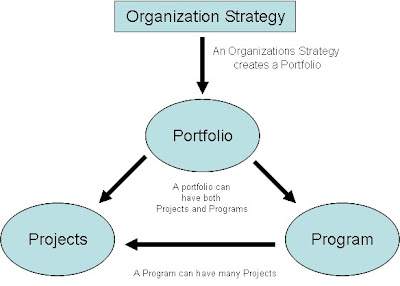
As you can see in the picture above, a portfolio is composed of projects, programs or both. And a program consists only of projects.
When compared to projects and programs, a portfolio is closer to an organization’s business objectives, and therefore this is where most of the investment decisions are made.
It’s also important to note that an operation is not part of a project. However, a program can include a non-project work. Similarly, a portfolio can also include work that is not included in any of its constituent projects and programs.
Let us wrap up this chapter with a comparison between projects, programs and portfolios.
Comparison between a Project, a Program, and Portfolio

Previous: Environmental Factors & Process Assets
Next: Other Terms Related to Project Management
So, lets get started!!!
Relationship between Project, Program and Portfolio:
As a project manager, you should know the basic concepts of program and portfolio and how they are related to each other and to projects. A program may be a part of a higher-level program; it certainly contains some interrelated projects, and it may contain some non-project work as well. Program management focuses on optimally managing the interdependencies among the various projects in the program. The person who manages a program is called the Program Manager.
The program manager’s responsibilities are:
• Prioritize to resolve resource conflict and constraints that affect multiple projects within his program.
• Keep your priorities aligned with the strategic goals and objectives of the organization.
• Resolve issues and manage change within the governance structure of the organization.
Just like a project is managed by a project manager, a program is managed by a program manager, who oversees the projects and provides high-level guidance to the project managers. In other words, a program manager oversees projects and coordinates efforts between projects but does not manage the projects.
Why is that?
That is because; we the project managers are managing our projects!!!
A portfolio contains both programs and projects and is managed by a portfolio manager. The portfolio is drawn directly from the strategic business plan of the organization.
The strategy of an organization is an action plan to achieve its business goals and objectives. It’s also called a strategic plan or a strategic business plan. The strategy determines the portfolio of projects and programs that the organization will execute. A portfolio is a set of projects, programs, or both that is managed in a coordinated fashion to obtain control and benefits not available from managing them individually.
What is Portfolio Management?
Portfolio management is the centralized management of one or more portfolios, and it includes identifying, prioritizing, authorizing, managing, and controlling projects, programs, and other related work in order to obtain specific strategic business objectives of the organization. Just as a program is managed by a program manager, a portfolio is managed by a portfolio manager.
To understand the relationship between these 3 entities, projects, programs and portfolios we need to understand that:
• If an organization does not have any programs but has only individual projects, all these projects can be grouped into one or more portfolios.
• If an organization has programs and no individual project external to all programs, all these programs can be grouped into one or more portfolios.
• If an organization has some programs and some individual projects, all these programs and projects can be grouped into one or more portfolios.
Portfolio management focuses on making sure that programs and projects are prioritized for resources to serve the organization’s strategy. In simpler terms, a portfolio manager worries about the success of the whole strategy put forth by the organization rather than the success of a single project (like what we do)
Therefore, investment decisions are usually made at the portfolio level. Program management focuses on achieving the benefits that would be aligned with the portfolio and hence with the strategic objectives of the organization. So, a portfolio is part of the interface between the programs and strategic business objectives of the organization for which the programs are run.
The relationship between these 3 entities is better explained by the picture below:
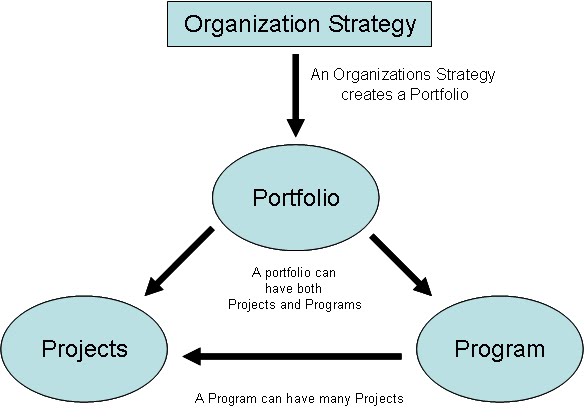
As you can see in the picture above, a portfolio is composed of projects, programs or both. And a program consists only of projects.
When compared to projects and programs, a portfolio is closer to an organization’s business objectives, and therefore this is where most of the investment decisions are made.
It’s also important to note that an operation is not part of a project. However, a program can include a non-project work. Similarly, a portfolio can also include work that is not included in any of its constituent projects and programs.
Let us wrap up this chapter with a comparison between projects, programs and portfolios.
Comparison between a Project, a Program, and Portfolio
Previous: Environmental Factors & Process Assets
Next: Other Terms Related to Project Management
Tuesday, May 3, 2011
Chapter 2: Introduction to Projects
Well, I am very excited to start writing this series of articles to help us prepare for the PMP Certification. We will be taking small steps one after the other and slowly reach our goal of the PMP certification. This is the first step in our pursuit.
So, lets get started!!!
What is a Project?
Anything and everything around us can be considered a project. For ex: building a nice home for you and your family is a project, same is the case if a government is trying to build a big power plant in your city. Irrespective of the size or the amount of money involved, both of them are projects.
What is common between these 2 examples? Your house and a power plant? Both involve, people, money and time. They both have a start and end and most importantly someone has to supervise the whole way to ensure that the project proceeds as planned and is completed on time and within budget.
The important point to note here is – someone has to supervise the whole way!!!
Yes, you read it right, any project has to be managed and controlled by an expert if it has to be a success. Failing which, the project will most probably be a failure.
Before we proceed any further, let me give you the technical definition of what a project is:
The definition is simple, isnt it? Now recollect, building your house is a project. You start it with a Grihapravesham (The Initial Pooja’s you do before beginning the construction), then you identify a builder, start buying raw materials like cement, steel, bricks etc, and go step by step and at the end of 9 months, voila your new and beautiful house is ready.
Since, you will no longer be building your house after 9 months, it is a temporary Endeavour and has a finite end at the end of construction.
Now I guess you understand the definition :-)
What is meant by Managing a Project?
Managing a project means managing the lifecycle of the project, starting from the beginning (initiating) and going to the end (closing); this is accomplished using processes, which constitute what are called project management knowledge areas. Although you use your knowledge in terms of processes to manage the projects, the management will be greatly influenced by the environment in which the project runs, such as the structure and culture of the performing organization.
If you want a quick synopsis of the various stages in the life of Managing a Project, just go back to the previous chapter and read it…
Terms you need to understand to begin your preparation:
Well, we have started our preparation for the PMP Exam. In the course of this and subsequent articles, we will be using various important terms. Each has a meaning and purpose. Now, let us go through each of them one by one.
• Organization
What is a Portfolio:
A portfolio is a set of projects, programs, and related work that is managed in a coordinated fashion to obtain business objectives in the strategic plan of the organization.
Portfolio management is the centralized management of one or more portfolios that includes identifying, authorizing, prioritizing, managing, and controlling projects, programs, and other related work in order to obtain specific business objectives in the strategic plan of the organization.
Now that we know the key terms that are required to continue our preparation, lets move on to the next topic…
Previous: Main parts in Managing a Project
Next: Understanding Projects
So, lets get started!!!
What is a Project?
Anything and everything around us can be considered a project. For ex: building a nice home for you and your family is a project, same is the case if a government is trying to build a big power plant in your city. Irrespective of the size or the amount of money involved, both of them are projects.
What is common between these 2 examples? Your house and a power plant? Both involve, people, money and time. They both have a start and end and most importantly someone has to supervise the whole way to ensure that the project proceeds as planned and is completed on time and within budget.
The important point to note here is – someone has to supervise the whole way!!!
Yes, you read it right, any project has to be managed and controlled by an expert if it has to be a success. Failing which, the project will most probably be a failure.
Exam Trivia:
Miracles do happen. But, in terms of the PMP Exam, Miracles are like the UFOs. Everyone has a doubt, but no one will risk their life to prove their existence. Similarly, there might be a rare case where an ill managed project becomes successful, our goal is to manage a project properly and as per the guidelines laid down by the PMI Institute to ensure that the project we are managing is a Success.
Before we proceed any further, let me give you the technical definition of what a project is:
A project is a work effort made over a finite period of time with a start and a finish to create a unique product, service, or result. Because a project has a start and an end, it is also called a temporary effort or endeavor
The definition is simple, isnt it? Now recollect, building your house is a project. You start it with a Grihapravesham (The Initial Pooja’s you do before beginning the construction), then you identify a builder, start buying raw materials like cement, steel, bricks etc, and go step by step and at the end of 9 months, voila your new and beautiful house is ready.
Since, you will no longer be building your house after 9 months, it is a temporary Endeavour and has a finite end at the end of construction.
Now I guess you understand the definition :-)
What is meant by Managing a Project?
Managing a project means managing the lifecycle of the project, starting from the beginning (initiating) and going to the end (closing); this is accomplished using processes, which constitute what are called project management knowledge areas. Although you use your knowledge in terms of processes to manage the projects, the management will be greatly influenced by the environment in which the project runs, such as the structure and culture of the performing organization.
If you want a quick synopsis of the various stages in the life of Managing a Project, just go back to the previous chapter and read it…
Terms you need to understand to begin your preparation:
Well, we have started our preparation for the PMP Exam. In the course of this and subsequent articles, we will be using various important terms. Each has a meaning and purpose. Now, let us go through each of them one by one.
Exam Trivia:
All these terms are simple and very important. You need to understand them in order to make sense of the subsequent topics. So pay attention!!!
• Organization
An organization is a group of individuals organized to work for some purpose or mission. Computer companies, telephone companies (to whom you pay your phone bills), and cable companies are examples of organizations. An organization might offer products, such as books, or services, such as Internet access or online banking. A project is usually performed inside an organization. Organization is a very broad concept that includes groups for profit and nonprofit, public and private, and government and nongovernment.• Project stakeholder
A project stakeholder is an individual or an organization that can be positively or negatively affected by the project execution. A project can have a wide array of stakeholders, like the project sponsor, the customer for whom you are executing the project, the end user who is going to use the system etc.• Process
A process is a set of related tasks performed to manage a certain aspect of a project, such as cost or quality. Each process belongs to a knowledge area and corresponds to a process group. There are a bunch of set guidelines that can help you achieve a goal and they are usually termed as processes.• Knowledge area
A knowledge area in project management is defined by its knowledge requirements related to managing a specific aspect of a project, such as cost, by using a set of processes. PMI recognizes a total of nine knowledge areas, such as cost management, human resource management etc.• Performing organization
The performing organization is the organization that is performing the project.• Project management
Project management is the usage of knowledge, skills, and tools to manage a project from start to finish with the goal of meeting the project requirements. It involves using the appropriate processes. Remember the Supervisor who is going to oversee your house construction• Program
A program is a set of related projects managed in a coordinated fashion to improve overall efficiency and effectiveness and to obtain benefits and control that would not be obtained by managing them individually. For example, a program could be delivering a product (or service) that consists of sub-products (or service components) delivered by the constituent projects. Also, a program might include related work that is not included in the scope of any of the constituent projects.• Program management
Program management is the centralized, coordinated management of a specific program to achieve its strategic goals, objectives, and benefits.• Program management office (PMO)
The program management office is an entity in an organization that is responsible for providing centralized, coordinated support to the program managers managing programs and unrelated projects.• Project management office
Project management office (PMO) refers to an entity in an organization that is responsible for providing centralized coordinated management and support for projects in the organization.
Exam Trivia:
Although both have the same abbreviation, PMO, the project management office and program management office are not identical. For example, only an organization that runs programs will have a program management office, whereas an organization that runs individual projects can have a project management office.
What is a Portfolio:
A portfolio is a set of projects, programs, and related work that is managed in a coordinated fashion to obtain business objectives in the strategic plan of the organization.
Portfolio management is the centralized management of one or more portfolios that includes identifying, authorizing, prioritizing, managing, and controlling projects, programs, and other related work in order to obtain specific business objectives in the strategic plan of the organization.
Now that we know the key terms that are required to continue our preparation, lets move on to the next topic…
Previous: Main parts in Managing a Project
Next: Understanding Projects
Subscribe to:
Posts (Atom)
Popular Posts
-
 So far, we have been talking in terms of projects only. There are two other terms that are closed linked with projects and project manageme...
 -
 In the previous chapter , we took a look at Expected Monetary Value or EMV Analysis . The Decision Tree Analysis is another tool/technique ...
 -
 In the previous chapter, we saw how to create the Project Scope Document. The next step in planning for a projects scope is to create the Wo...
 -
 In the previous chapter, we saw the project lifecycle in detail. In this chapter, we are going to take a look at the Project Management Kno...
 -
 In the previous chapter we learnt how to create the project human resource plan. To get resources you need to spend money (Cost) and you can...
 -
 In the previous chapter , we learnt the basic details about Continuous Distributions. In this chapter, we are going to take a detailed look...
 -
 In the previous chapter we learnt that the risk register is going to be constantly updated as we progress through the various processes in...
 -
Expected Monetary Value Analysis or EMV Analysis in short is the 2nd tool and technique in the Quantitative Risk Analysis and Modeling Tech...
-
 In the previous chapter, we saw that an organizations policies and culture can have a significant impact on a project. Towards the end we al...
 -
 In the previous chapter, we took a look at how to sequence the activities based on the requirements and dependencies. The next step would be...