Let us wrap up the Project Scope Planning topic by reviewing the important terms and definitions we have learnt as part of this topic.
• Alternatives identification - A technique used to apply nonstandard approaches, such as brainstorming and lateral thinking, to perform project work.
• Baseline - A reference plan for components, such as schedule, scope, and cost, against which performance deviations are measured. The reference plan can be the original or the modified plan.
• Brainstorming - A creative technique generally used in a group environment to gather ideas as candidates for a solution to a problem or an issue without any immediate evaluation of these ideas. The evaluation and analysis of these ideas happens later.
• Code of accounts - A numbering system used to uniquely identify each component of a WBS.
• Configuration management - Refers to controlling the characteristics of a product, a service, or a result of a project. It includes documenting the features of a product or a service, controlling and documenting changes to the features, and providing support for auditing the products for conformance to requirements.
• Control account - A node in the WBS that acts as a management control point where scope, schedule, and actual cost are integrated and compared to the earned value to measure the project performance.
• Decomposition - A planning technique to subdivide the project scope, including deliverables, into smaller, manageable tasks called work packages.
• Deliverable - A unique and verifiable product, a capability to provide a service, or a result that must be produced to complete a project or a process or phase of the project.
• Lateral thinking - Thinking outside the box, beyond the realm of your experience, to search for new solutions and methods, rather than only better uses of the current solutions and methods.
• Planning package - A WBS component that is below the control account that has a well-defined work content but does not yet have a detailed schedule.
• Product scope - Features and functions that characterize a product, service, or result to be delivered by the project.
• Project management plan - An approved document that describes how the project will be executed, monitored and controlled, and closed.
• Project scope - The work that must be performed (and only that work) to deliver products, services, or results with specified features that were promised by the project. The project scope draws the boundaries around the project—what is included and what is not.
• Project scope statement - A document that defines the scope of a project by stating what needs to be accomplished by the project.
• Requirement - A condition, characteristic, or capability that a specific outcome of the project must have.
• Rolling wave planning - A case of progressive elaboration in which the deliverables about which full information is available are decomposed to the lowest level, whereas the deliverables for which full information is not available are left at higher levels until the information becomes available.
• Scope baseline - The reference scope against which all the scope deviations are measured. It consists of the scope statement, the WBS document, and the WBS dictionary.
• Scope definition - The process used to develop the detailed project scope statement.
• Scope planning - The process of developing the project scope management plan.
• Subprojects - Parts of the main projects that are independent enough that each can be performed by separate project teams.
• Work breakdown structure (WBS) - A deliverable-oriented hierarchical structure that displays the decomposition of deliverables into work, which must be performed to accomplish the project objectives and create the project deliverables.
• Work package - A deliverable or a task at the lowest level of each branch of the WBS.
Previous: Summary - Project Scope Planning
Next: Introduction to Project Schedule
Showing posts with label project scope. Show all posts
Showing posts with label project scope. Show all posts
Monday, May 16, 2011


Summary - Project Scope Planning
In the previous chapters, we have successfully completed the Project Scope Planning section of Project Planning. Let us quickly summarize the key points we learnt in this topic.
• After a project has been initiated, the project management plan is developed to specify how the project at hand will be executed, monitored & controlled, and closed.
• The project management plan can contain subsidiary plans, such as a quality management plan, a risk management plan, a project scope management plan, and a scope baseline.
• The scope baseline consists of the project scope statement, work breakdown structure (WBS), and WBS dictionary.
• Collecting requirements is part of the scope planning, which creates requirements documentation.
• The project charter and requirements documentation are used to define the scope, which creates the project scope statement.
• The project scope statement is a document that defines the scope of a project, including the product scope, by stating what needs to be accomplished by the project.
• It includes project deliverables, product description, product acceptance criteria, assumptions and constraints, and project exclusions.
• The project scope statement and requirements documentation are input items to creating the work breakdown structure (WBS), which is a breakdown of project deliverables into manageable pieces called work packages, which in turn are used to develop the project schedule.
• The WBS is supported by another document called the WBS dictionary, which offers details for the WBS components.
• The scope statement, the WBS document, and the WBS dictionary combined constitute the scope baseline against which all change requests are evaluated.
• The WBS is the heart of project management, as it is used in managing many aspects of the project, including developing the schedule.
Previous: Before & After WBS
Next: Important Terms - Project Scope Planning
• After a project has been initiated, the project management plan is developed to specify how the project at hand will be executed, monitored & controlled, and closed.
• The project management plan can contain subsidiary plans, such as a quality management plan, a risk management plan, a project scope management plan, and a scope baseline.
• The scope baseline consists of the project scope statement, work breakdown structure (WBS), and WBS dictionary.
• Collecting requirements is part of the scope planning, which creates requirements documentation.
• The project charter and requirements documentation are used to define the scope, which creates the project scope statement.
• The project scope statement is a document that defines the scope of a project, including the product scope, by stating what needs to be accomplished by the project.
• It includes project deliverables, product description, product acceptance criteria, assumptions and constraints, and project exclusions.
• The project scope statement and requirements documentation are input items to creating the work breakdown structure (WBS), which is a breakdown of project deliverables into manageable pieces called work packages, which in turn are used to develop the project schedule.
• The WBS is supported by another document called the WBS dictionary, which offers details for the WBS components.
• The scope statement, the WBS document, and the WBS dictionary combined constitute the scope baseline against which all change requests are evaluated.
• The WBS is the heart of project management, as it is used in managing many aspects of the project, including developing the schedule.
Previous: Before & After WBS
Next: Important Terms - Project Scope Planning
Chapter 30: Defining the Project Scope
In the previous chapter, we saw how to capture requirements for a project. The next step in managing a project after we gather the requirements is to define the Project Scope. In this chapter, we are going to take a look at how exactly this project scope definition happens.
So, lets get started!!!
What is Project Scope?
We have gone through this multiple times over the course of the previous chapters but still for the sake of completeness lets define project scope here as well. A Projects Scope outlines what work will be done/accomplished as part of the project and also outlines what would not be done as part of the current project.
Why is Scope Definition Important?
Do I need to say why scope definition is important? Without a list of what needs to be done, how can you expect a team to execute a project? Without knowing what to do, the team will be lost and eventually the project will be a failure.
Beginning Scope Definition
The project charter developed during initiation and the stakeholder requirements document, also called the requirement documentation, contain enough information about the project and the product to start defining the project scope. Now that the project is in the planning stage, you have more information than you had in the initiation stage. Therefore, you are in a better position to analyze the needs and expectations related to the project and convert them into requirements. Furthermore, the assumptions and constraints can be revisited and analyzed at greater length, and additional assumptions and constraints can be identified. This will help to define the project scope with more clarity and specificity.
Purpose of the Project Scope Statement:
The Project Scope Statement is the output of the Project Scope Definition activity. The project scope statement serves the following purposes:
Scope Definition Process
The scope definition process can be summarized at a high level using the picture below:
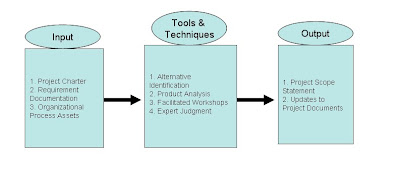
As you can see in the picture, the scope definition process uses some inputs, applies some tools and techniques and then produces the output: which in this case will be the project scope document. Let us now take a look at these 3 steps in detail.
Input to Scope Definition
The project charter developed during project initiation presents the high-level project and product description. It also contains other information relevant to defining the scope, such as the project approval requirements. Project and product requirements listed in the requirement documentation also contain critical information for defining the scope.
Some of the organizational process assets that can be helpful in defining the scope are:
Tools and Techniques for Scope Definition
The Tools and Techniques used for Scope Definition are:
• Identification of alternatives - This is a technique used to apply nonstandard approaches to perform project work; in this case, to define the project scope. A host of general management techniques can be used in this category; the most common ones are brainstorming and lateral thinking. Brainstorming was covered in detail in the previous chapter. Lateral thinking is synonymous with thinking outside the box. The idea is to think beyond the realm of your experience to search for new solutions and methods, not just better uses of the current ones.
• Product analysis - To finalize the details of the project scope, you might need to perform product analysis, which might include techniques such as product breakdown, requirement analysis, system analysis, system engineering, value analysis, and value engineering. The goal is to translate the project objectives into tangible deliverables and requirements.
• Facilitated workshops - The facilitated workshops described in the Previous Chapter can also be used in defining the scope.
• Expert judgment - You can use help from relevant experts in the organization to develop parts of the detailed project scope.
Output of Scope Definition
Depending on the input, the scope definition process can generate two kinds of output:
1. The project scope statement that contains the original scope definition and
2. Updates to some project documents
Changes and Updates
In the process of defining the project scope, you may end up modifying the existing requirements or adding new requirements. You may also learn more about the stakeholders. So, the documents that may be updated as a result of defining the scope are:
• Requirements documentation
• Requirements traceability matrix
• Stakeholder register
Project Scope Statement
The key output item of the Define Project process is the project scope statement, which is sometimes also called the detailed project scope statement or just the scope statement. The scope statement basically states what needs to be accomplished by the project.
It provides a documented baseline for the following:
• Developing a common understanding among the stakeholders about the project scope
• Making project decisions throughout the lifecycle of the project
• Measuring performance deviations from the scope
The specific elements of the project scope statement are:
• Project assumptions and constraints - Assumptions and constraints are initially included in the project charter. However, at this stage, you have more information about the project, and therefore you can revisit the initial assumptions and constraints, and you might be able to identify more assumptions and constraints. You should document the specific assumptions related to the project scope and also analyze their impact in case they turn out to be false. Due to the uncertainty built into them, the assumptions are potential sources of risk.
The constraints related to the project scope must also be documented in the scope statement. Because the constraints limit the team’s options, the constraints’ impact on the project must be evaluated. The constraints can come from various sources, such as a predetermined deadline for the completion of the project or a milestone, limits on the funds available for the project, and contractual provisions. However, the following are common constraints to consider across all projects:
o Quality
o Resources
o Scope
o Time
Some of the other terms which we might use in the subsequent chapters related to this topic are:
• Project deliverables - A deliverable is a unique and verifiable product, a capability to provide a service, or a result that must be produced to complete a project, a process, or a phase of the project. The deliverables can also include project management reports and documents. The scope statement provides the list of deliverables and their descriptions.
• Project exclusions - This involves drawing boundaries around the project by specifying what is included and what is not, especially focusing on the gray areas where the stakeholders can make their own assumptions, different from each other. It generally identifies what is excluded from the project, which helps to manage stakeholder expectations.
• Product description - The scope statement must describe the product scope and the product acceptance criteria.
o Product scope description - Product scope is defined as features and functions that characterize a product, service, or result to be delivered by the project. The requirements documentation produced during the Collect Requirements process will help define the product scope.
o Product acceptance criteria - This defines the process and criteria for accepting the completed products that the project will deliver.
Previous: Requirements Collection Process
Next: Creating WBS
So, lets get started!!!
What is Project Scope?
We have gone through this multiple times over the course of the previous chapters but still for the sake of completeness lets define project scope here as well. A Projects Scope outlines what work will be done/accomplished as part of the project and also outlines what would not be done as part of the current project.
Why is Scope Definition Important?
Do I need to say why scope definition is important? Without a list of what needs to be done, how can you expect a team to execute a project? Without knowing what to do, the team will be lost and eventually the project will be a failure.
Beginning Scope Definition
The project charter developed during initiation and the stakeholder requirements document, also called the requirement documentation, contain enough information about the project and the product to start defining the project scope. Now that the project is in the planning stage, you have more information than you had in the initiation stage. Therefore, you are in a better position to analyze the needs and expectations related to the project and convert them into requirements. Furthermore, the assumptions and constraints can be revisited and analyzed at greater length, and additional assumptions and constraints can be identified. This will help to define the project scope with more clarity and specificity.
Purpose of the Project Scope Statement:
The Project Scope Statement is the output of the Project Scope Definition activity. The project scope statement serves the following purposes:
• It serves as a component to the baseline that will be used to evaluate whether the request for a change or additional work falls within or beyond the scope of the project.
• By providing a common understanding of the project scope, the scope statement helps bring the stakeholders onto the same page in their expectations.
• Because the scope statement describes the deliverables and the work required to create those deliverables, it is used to create a WBS, which helps in scheduling the project.
• It serves as a guide for the project team to do more in-depth planning, if necessary, and to perform work during project execution.
Scope Definition Process
The scope definition process can be summarized at a high level using the picture below:

As you can see in the picture, the scope definition process uses some inputs, applies some tools and techniques and then produces the output: which in this case will be the project scope document. Let us now take a look at these 3 steps in detail.
Input to Scope Definition
The project charter developed during project initiation presents the high-level project and product description. It also contains other information relevant to defining the scope, such as the project approval requirements. Project and product requirements listed in the requirement documentation also contain critical information for defining the scope.
Some of the organizational process assets that can be helpful in defining the scope are:
• Template for the project scope statement
• Scope-related project files from previous projects
• Lessons learned from previous projects or from previous phases of this project
• Policies and procedures relevant to defining the project scope
Trivia:
It’s critical to the success of the project that you determine the scope correctly: only the required features and functions for the product and only the required work to produce those features and functions; nothing less, nothing more.
Tools and Techniques for Scope Definition
The Tools and Techniques used for Scope Definition are:
• Identification of alternatives - This is a technique used to apply nonstandard approaches to perform project work; in this case, to define the project scope. A host of general management techniques can be used in this category; the most common ones are brainstorming and lateral thinking. Brainstorming was covered in detail in the previous chapter. Lateral thinking is synonymous with thinking outside the box. The idea is to think beyond the realm of your experience to search for new solutions and methods, not just better uses of the current ones.
• Product analysis - To finalize the details of the project scope, you might need to perform product analysis, which might include techniques such as product breakdown, requirement analysis, system analysis, system engineering, value analysis, and value engineering. The goal is to translate the project objectives into tangible deliverables and requirements.
• Facilitated workshops - The facilitated workshops described in the Previous Chapter can also be used in defining the scope.
• Expert judgment - You can use help from relevant experts in the organization to develop parts of the detailed project scope.
Output of Scope Definition
Depending on the input, the scope definition process can generate two kinds of output:
1. The project scope statement that contains the original scope definition and
2. Updates to some project documents
Changes and Updates
In the process of defining the project scope, you may end up modifying the existing requirements or adding new requirements. You may also learn more about the stakeholders. So, the documents that may be updated as a result of defining the scope are:
• Requirements documentation
• Requirements traceability matrix
• Stakeholder register
Project Scope Statement
The key output item of the Define Project process is the project scope statement, which is sometimes also called the detailed project scope statement or just the scope statement. The scope statement basically states what needs to be accomplished by the project.
It provides a documented baseline for the following:
• Developing a common understanding among the stakeholders about the project scope
• Making project decisions throughout the lifecycle of the project
• Measuring performance deviations from the scope
The specific elements of the project scope statement are:
• Project assumptions and constraints - Assumptions and constraints are initially included in the project charter. However, at this stage, you have more information about the project, and therefore you can revisit the initial assumptions and constraints, and you might be able to identify more assumptions and constraints. You should document the specific assumptions related to the project scope and also analyze their impact in case they turn out to be false. Due to the uncertainty built into them, the assumptions are potential sources of risk.
The constraints related to the project scope must also be documented in the scope statement. Because the constraints limit the team’s options, the constraints’ impact on the project must be evaluated. The constraints can come from various sources, such as a predetermined deadline for the completion of the project or a milestone, limits on the funds available for the project, and contractual provisions. However, the following are common constraints to consider across all projects:
o Quality
o Resources
o Scope
o Time
Some of the other terms which we might use in the subsequent chapters related to this topic are:
• Project deliverables - A deliverable is a unique and verifiable product, a capability to provide a service, or a result that must be produced to complete a project, a process, or a phase of the project. The deliverables can also include project management reports and documents. The scope statement provides the list of deliverables and their descriptions.
• Project exclusions - This involves drawing boundaries around the project by specifying what is included and what is not, especially focusing on the gray areas where the stakeholders can make their own assumptions, different from each other. It generally identifies what is excluded from the project, which helps to manage stakeholder expectations.
• Product description - The scope statement must describe the product scope and the product acceptance criteria.
o Product scope description - Product scope is defined as features and functions that characterize a product, service, or result to be delivered by the project. The requirements documentation produced during the Collect Requirements process will help define the product scope.
o Product acceptance criteria - This defines the process and criteria for accepting the completed products that the project will deliver.
Trivia:
You must be able to make a distinction between objectives, deliverables, and requirements. For example, in a project to launch a website, the website is a deliverable. That the website must print a warning message at the login time is a requirement, and that the website should increase the company revenue by 3 percent is an objective.
Previous: Requirements Collection Process
Next: Creating WBS
Friday, May 13, 2011
Chapter 27: Managing Scope
In the previous chapter, we saw how important it is to create the Project Management Plan and also about how to create it. Let us now get into the Scope Management part of our Project Planning phase.
What is Scope?
The scope of a project consists of the project scope and the product scope. The project scope is defined as the work that must be performed to deliver the required products, services, or results with the specified functions and features. The product scope is the set of functions and features that characterize a product, service, or result to be delivered by the current project.
It is about both what is included in the project and what is not. In other words, scoping a project means drawing boundaries around it, so that everyone knows what will be done and what will not be done. The importance of managing the project scope cannot be overemphasized because it has a profound impact on the overall success of the project.
Is Scope Management Important?
If you feel the scope management is not important, imagine this:
Let’s say you started a project to deliver an online banking website for ABC Bank and are 6 months into development. The go live date is in 12 weeks and the customer wants to include credit card information in the website. This was not part of the initial estimates & scope.
Unfortunately, your project manager accepted this because he wanted to please the customer.
Now think what will happen to you and your team mates? You all will be neck deep in unexpected work and the next 12 weeks will be most miserable work days of your life and that is only if you manage to deliver the project to the customer. If you don't, then its only going to get worse…
If your project manager had put his foot down and said, the credit card details were not part of the initial scope & estimate and a change of this magnitude cannot be taken up in such a short notice of 12 weeks, imagine the scenario…
Now you get the idea of why scope management is important?
What is Project Scope Management
The major goal of scope management is to ensure that the required work and only the required work is included and performed in the project.
Just go back to the previous paragraph and read the example. If the project manager had a scope management document that outlined the list of tasks that will be completed as part of the project, he could use that to substantiate his argument that, such a large chunk of work cannot be taken up this late in the project execution.
The Project Scope Management will do the following:
1. Collect requirements - Define the project and product requirements and develop a plan to manage those requirements. This will help clarify what needs to be done.
2. Define scope - Develop a detailed description of the project and the product that will determine what needs to be done.
3. Create work breakdown structure (WBS) - Break down the scope into concrete, manageable components.
4. Verify scope - Formalize the acceptance of the completed project deliverables. Identify how you will verify that the project scope has been executed as planned.
5. Control scope - Determine how to monitor the status of the project and product scope and monitor and control changes to the scope.
Let us take a picture to understand this better.

Note: The above picture is a high level view. Each stage may involve an in depth analysis by the Project Manager to capture accurate information.
Let us now take a look at which process group each of these activities belong to and what the output of these activities would be.
Developing the Project Scope Management Plan
Before starting to perform the five scope management processes, you develop the scope management plan. This work is recommended to be part of the effort of developing the project management plan. This plan will work as a guide for handling the following:
Whether the project scope management plan is informal and high-level (without too much detail) or formal and detailed depends upon the size, complexity, and needs of the project.
The project scope management plan becomes part of the project management plan.
So, the project scope planning specifies how to define, verify, and control the project. Before you can actually define the scope, though, you need to have a very crucial item in place: stakeholder requirements.
Previous: Developing Project Management Plan
Next: Collecting Requirements
What is Scope?
The scope of a project consists of the project scope and the product scope. The project scope is defined as the work that must be performed to deliver the required products, services, or results with the specified functions and features. The product scope is the set of functions and features that characterize a product, service, or result to be delivered by the current project.
It is about both what is included in the project and what is not. In other words, scoping a project means drawing boundaries around it, so that everyone knows what will be done and what will not be done. The importance of managing the project scope cannot be overemphasized because it has a profound impact on the overall success of the project.
Trivia:
Project scope is not the same thing as the product scope. Project scope is the work required to deliver the product scope.
Is Scope Management Important?
If you feel the scope management is not important, imagine this:
Let’s say you started a project to deliver an online banking website for ABC Bank and are 6 months into development. The go live date is in 12 weeks and the customer wants to include credit card information in the website. This was not part of the initial estimates & scope.
Unfortunately, your project manager accepted this because he wanted to please the customer.
Now think what will happen to you and your team mates? You all will be neck deep in unexpected work and the next 12 weeks will be most miserable work days of your life and that is only if you manage to deliver the project to the customer. If you don't, then its only going to get worse…
If your project manager had put his foot down and said, the credit card details were not part of the initial scope & estimate and a change of this magnitude cannot be taken up in such a short notice of 12 weeks, imagine the scenario…
Now you get the idea of why scope management is important?
What is Project Scope Management
The major goal of scope management is to ensure that the required work and only the required work is included and performed in the project.
Just go back to the previous paragraph and read the example. If the project manager had a scope management document that outlined the list of tasks that will be completed as part of the project, he could use that to substantiate his argument that, such a large chunk of work cannot be taken up this late in the project execution.
The Project Scope Management will do the following:
1. Collect requirements - Define the project and product requirements and develop a plan to manage those requirements. This will help clarify what needs to be done.
2. Define scope - Develop a detailed description of the project and the product that will determine what needs to be done.
3. Create work breakdown structure (WBS) - Break down the scope into concrete, manageable components.
4. Verify scope - Formalize the acceptance of the completed project deliverables. Identify how you will verify that the project scope has been executed as planned.
5. Control scope - Determine how to monitor the status of the project and product scope and monitor and control changes to the scope.
Let us take a picture to understand this better.

Note: The above picture is a high level view. Each stage may involve an in depth analysis by the Project Manager to capture accurate information.
Let us now take a look at which process group each of these activities belong to and what the output of these activities would be.
| Scope Management Process | Process Group | Output |
|---|---|---|
| Collect Requirements | Planning | Requirement management plan and other requirement documents |
| Define Scope | Planning | Project scope statement |
| Create WBS | Planning | WBS and scope baseline |
| Verify Scope | Monitoring and controlling | Acceptance of deliverables and change requests |
| Control Scope | Monitoring and controlling | Work performance measurements |
Before starting to perform the five scope management processes, you develop the scope management plan. This work is recommended to be part of the effort of developing the project management plan. This plan will work as a guide for handling the following:
• How can you define the scope? To answer this question, the scope management plan includes the following:
o A process to prepare a detailed project scope statement based on the preliminary project scope statement.
o A process that will enable the creation of the work breakdown structure (WBS) from the detailed project scope statement and will establish how the WBS will be maintained and approved.
• How can you verify the scope? The scope management plan answers this question by including a process that describes how the formal verification and acceptance of the completed project deliverables will be obtained.
• How can you control the scope? The scope management plan answers this question by including a process that specifies how the requests for changes to the detailed project scope statement (which we also refer to as the scope statement) will be processed.
Whether the project scope management plan is informal and high-level (without too much detail) or formal and detailed depends upon the size, complexity, and needs of the project.
The project scope management plan becomes part of the project management plan.
So, the project scope planning specifies how to define, verify, and control the project. Before you can actually define the scope, though, you need to have a very crucial item in place: stakeholder requirements.
Previous: Developing Project Management Plan
Next: Collecting Requirements
Wednesday, May 11, 2011
Chapter 25: Introduction to Project Planning
After the project has been initiated, you need to develop a project management plan, which becomes the primary source of information for how the project you are currently managing will be executed, monitored & controlled, and closed.
In this chapter, we are going to take a look at how a Project Manager would begin this planning phase.
So, lets get started!!!
Planning the Project
Once the project has been initiated, it’s time to do some planning. As I said in the previous chapter, any project that does not have a proper plan seldom succeeds. So, as the project manager it is our responsibility to plan properly and to ensure that our project is a success. This includes determining the project scope, during which time you’ll refine the project objectives and determine things like:
• How the scope will be executed
• How the execution will be monitored and controlled, and
• How the project will be brought to a proper closure.
Project planning is embodied in the project management plan that is developed through progressive elaboration. The project management plan is a document that defines, prepares, coordinates, and integrates all subsidiary plans, such as scope and risk management plans, into one plan. The goal here is to develop a source of information that will work as a guideline for how the project will be executed, monitored and controlled, and closed.
How Important is Project Planning?
Let us take a real time example to explain this. Lets assume that you are going to get married and for the sake of comparison, lets compare this marriage to a project. (I know it's a bad analogy but I think it would be a good example to explain the whole importance part of it)
Once you decide to get married, you need to fix a marriage hall, print invitations, send them to all your friends, meet up close friends & family members and invite them, arrange caterers, arrange decoration parties who will decorate the marriage hall during the events, arrange for flowers and garlands, buy new cloths, jewels for the bride, and on and on. The list is very long. Unless someone from the couples family (Usually the Fathers of the bride & groom) sit down and do extensive planning to ensure that the event is a success.
Imagine, what a disaster it would be to realize that the flowers & garlands werent ordered and the bride and groom are ready to tie the knot on the stage? Forget the disaster, it would be embarrassing for the couple and their close family members to see such an event.
Fortunately, the project managers (the dads of the couple) wouldn't let such a thing happen and plan it all out properly to result in a successful and happy wedding.
I guess, by now you have understood the importance of planning on the success of a project.
Elements of Project Planning
The planning phase of any project would involve 3 important things:
It is important to plan the project because not all projects need all the planning processes, nor do they all need them with the same level. Therefore, the content of the project management plan, the ultimate output of project planning, will depend upon the project under consideration.
As the project goes through different stages, the project management plan may be updated and revised through the change control process. Following are some issues that project planning phase addresses:
Note: This list is not exhaustive and the project plan may include a lot more than this.
Trivia:
The project baseline is defined as the approved plan for the scope, schedule, and cost of the project. The project performance is measured against this baseline, and therefore this baseline is also called the performance baseline. The project baseline is also referred to in terms of its components: cost baseline, schedule baseline, and scope baseline. How do you know how the project is performing? You compare the performance to the baseline. Approved changes in scope, schedule, or cost will obviously change the baseline.
Let us take a look at a pictorial representation of how the Project Management Plan is Prepared.

Before I begin explanation, this is just a high level view. The details involved in each of these steps might be more complicated and may require a lot of effort.
The output of the project Initiation Phase is the Project Charter, Stakeholder Register and the Stakeholder Management Strategy. These are the inputs in the process of creating the Project Management Plan.
Depending upon the complexity of the project, the project management plan can be either a summary or a collection of subsidiary plans and components, which might include:
In a nutshell, project planning involves determining exactly what will be done and how it will be done. Executing a project means implementing the project management plan for that project. Therefore, the project management plan contains the project scope that defines what needs to be done to meet the project objectives.
But how exactly is the project management plan actually developed? Don't worry, that is what our next chapter is going to explain…
Previous: Planning a Project
Next: Developing the Project Management Plan
In this chapter, we are going to take a look at how a Project Manager would begin this planning phase.
So, lets get started!!!
Planning the Project
Once the project has been initiated, it’s time to do some planning. As I said in the previous chapter, any project that does not have a proper plan seldom succeeds. So, as the project manager it is our responsibility to plan properly and to ensure that our project is a success. This includes determining the project scope, during which time you’ll refine the project objectives and determine things like:
• How the scope will be executed
• How the execution will be monitored and controlled, and
• How the project will be brought to a proper closure.
Project planning is embodied in the project management plan that is developed through progressive elaboration. The project management plan is a document that defines, prepares, coordinates, and integrates all subsidiary plans, such as scope and risk management plans, into one plan. The goal here is to develop a source of information that will work as a guideline for how the project will be executed, monitored and controlled, and closed.
Trivia:
It is important for any project to have a good plan. It is possible that the project manager might leave the company or move on to another critical project where his/her expertise is needed and leave the current project to another manager. Eitherways, the presence of a good project plan will help the new manager, whomsoever it might be, to handle and manage the project effectively.
How Important is Project Planning?
Let us take a real time example to explain this. Lets assume that you are going to get married and for the sake of comparison, lets compare this marriage to a project. (I know it's a bad analogy but I think it would be a good example to explain the whole importance part of it)
Once you decide to get married, you need to fix a marriage hall, print invitations, send them to all your friends, meet up close friends & family members and invite them, arrange caterers, arrange decoration parties who will decorate the marriage hall during the events, arrange for flowers and garlands, buy new cloths, jewels for the bride, and on and on. The list is very long. Unless someone from the couples family (Usually the Fathers of the bride & groom) sit down and do extensive planning to ensure that the event is a success.
Imagine, what a disaster it would be to realize that the flowers & garlands werent ordered and the bride and groom are ready to tie the knot on the stage? Forget the disaster, it would be embarrassing for the couple and their close family members to see such an event.
Fortunately, the project managers (the dads of the couple) wouldn't let such a thing happen and plan it all out properly to result in a successful and happy wedding.
I guess, by now you have understood the importance of planning on the success of a project.
Elements of Project Planning
The planning phase of any project would involve 3 important things:
1. Refining the project objectives defined during project initiation and collecting requirements based on the stakeholder needs and expectations.
2. Determining the scope of the project.
3. Determining the course of action required to attain these objectives, which involves breaking down the scope and objectives into concrete, manageable tasks.
It is important to plan the project because not all projects need all the planning processes, nor do they all need them with the same level. Therefore, the content of the project management plan, the ultimate output of project planning, will depend upon the project under consideration.
As the project goes through different stages, the project management plan may be updated and revised through the change control process. Following are some issues that project planning phase addresses:
• Which project management processes will be used for the project, what the level of implementation for each of the processes will be, and what the inputs and tools and techniques for the processes are
• The project baseline against which the performance of the project will be measured and against which the project will be monitored and controlled
• How the changes to the approved plan will be monitored and controlled
• What the needs and techniques for communication among the stakeholders are
• How the project lifecycle looks, including the project phases if the project is a multiphase one
Note: This list is not exhaustive and the project plan may include a lot more than this.
Trivia:
The project baseline is defined as the approved plan for the scope, schedule, and cost of the project. The project performance is measured against this baseline, and therefore this baseline is also called the performance baseline. The project baseline is also referred to in terms of its components: cost baseline, schedule baseline, and scope baseline. How do you know how the project is performing? You compare the performance to the baseline. Approved changes in scope, schedule, or cost will obviously change the baseline.
Let us take a look at a pictorial representation of how the Project Management Plan is Prepared.

Before I begin explanation, this is just a high level view. The details involved in each of these steps might be more complicated and may require a lot of effort.
The output of the project Initiation Phase is the Project Charter, Stakeholder Register and the Stakeholder Management Strategy. These are the inputs in the process of creating the Project Management Plan.
Depending upon the complexity of the project, the project management plan can be either a summary or a collection of subsidiary plans and components, which might include:
• Standard plans from different aspects of project planning, such as the cost management plan, communication management plan, scope management plan, and risk management plan.
• Other components, such as the milestones list, the resource calendar, and baselines for scope, schedule, cost, and quality. A baseline is a reference plan against which all the performance deviations are measured. This reference plan can be the original or the updated plan.
In a nutshell, project planning involves determining exactly what will be done and how it will be done. Executing a project means implementing the project management plan for that project. Therefore, the project management plan contains the project scope that defines what needs to be done to meet the project objectives.
But how exactly is the project management plan actually developed? Don't worry, that is what our next chapter is going to explain…
Previous: Planning a Project
Next: Developing the Project Management Plan
Important Terms and Definitions - Project Initiation
The following are some important Terms that we have learnt as part of the Project Initiation Phase.
• Assumption - A factor that you consider to be true without any proof or verification. Assumptions can appear in both the input and the output of various processes.
• Constraint - A restriction that can affect the performance of the project.
• Initiating process group - A process group that contains two processes: develop project charter and develop preliminary project scope statement.
• Project charter - A document that states the initial requirements to satisfy the stakeholders’ needs and expectations and also formally authorizes the project.
• Project Management Information System (PMIS) - An information system that consists of tools used to store, integrate, and retrieve the outputs of the project management processes. This can be used to support all stages of the project from initiating to closing.
• Project scope - The work that must be performed to deliver a product, service, or results with the specified features. The project scope draws the boundaries around the project: what is included and what is not.
• Stakeholder management strategy - The approach developed to deal with the stakeholders in the best interests of the project.
• Stakeholder register - A document that identifies the project stakeholders and the relevant information about them.
• Statement of work (SOW) - A document that describes the products or services to be delivered by the project. It is an input to developing the project charter and the preliminary project scope statement.
Previous: Summary - Project Initiation
Next: Project Planning
• Assumption - A factor that you consider to be true without any proof or verification. Assumptions can appear in both the input and the output of various processes.
• Constraint - A restriction that can affect the performance of the project.
• Initiating process group - A process group that contains two processes: develop project charter and develop preliminary project scope statement.
• Project charter - A document that states the initial requirements to satisfy the stakeholders’ needs and expectations and also formally authorizes the project.
• Project Management Information System (PMIS) - An information system that consists of tools used to store, integrate, and retrieve the outputs of the project management processes. This can be used to support all stages of the project from initiating to closing.
• Project scope - The work that must be performed to deliver a product, service, or results with the specified features. The project scope draws the boundaries around the project: what is included and what is not.
• Stakeholder management strategy - The approach developed to deal with the stakeholders in the best interests of the project.
• Stakeholder register - A document that identifies the project stakeholders and the relevant information about them.
• Statement of work (SOW) - A document that describes the products or services to be delivered by the project. It is an input to developing the project charter and the preliminary project scope statement.
Previous: Summary - Project Initiation
Next: Project Planning
Subscribe to:
Posts (Atom)
Popular Posts
-
 So far, we have been talking in terms of projects only. There are two other terms that are closed linked with projects and project manageme...
 -
 In the previous chapter , we took a look at Expected Monetary Value or EMV Analysis . The Decision Tree Analysis is another tool/technique ...
 -
 In the previous chapter, we saw how to create the Project Scope Document. The next step in planning for a projects scope is to create the Wo...
 -
 In the previous chapter, we saw the project lifecycle in detail. In this chapter, we are going to take a look at the Project Management Kno...
 -
 In the previous chapter we learnt how to create the project human resource plan. To get resources you need to spend money (Cost) and you can...
 -
 In the previous chapter , we learnt the basic details about Continuous Distributions. In this chapter, we are going to take a detailed look...
 -
 In the previous chapter we learnt that the risk register is going to be constantly updated as we progress through the various processes in...
 -
Expected Monetary Value Analysis or EMV Analysis in short is the 2nd tool and technique in the Quantitative Risk Analysis and Modeling Tech...
-
 In the previous chapter, we saw that an organizations policies and culture can have a significant impact on a project. Towards the end we al...
 -
 In the previous chapter, we took a look at how to sequence the activities based on the requirements and dependencies. The next step would be...