Showing posts with label portfolio management. Show all posts

Friday, March 17, 2017

Project Program and Portfolio Management

Even though the PMI ACP is focused at managing projects the agile way, as a project manager we would still need to know the difference between a Project, Program and a Portfolio to be able to do our jobs better. Most people have a misconception that they are one and the same. Hopefully by the end of this article you would understand that they are not the same. 

In the Series on PMP Exam Prep, I had published an article titled “Relationship between Project, Program and Portfolio” which you should visit to understand more details as I wont be covering the exam same details once again here. Click here

What is Project Management? 

According to the PMBOK – Project Management is the application of Knowledge, Skills, Tools and Techniques to Project Activities to meet the Project Requirements. 

Project management aims to converts the abstract concept or vision the organization has to reality.

Trivia: Remember the Trivia from the Previous Article on Project Life cycle? Even though every project goes through the 5 life cycle stages as per project management standards, the number of steps or phases in an actual industry project need not have the exact same 5 stages/phases. You need to keep this difference in mind when answering Questions. 

WHY DO PROJECT MANAGERS NEED SOFT SKILLS?

The Project Manager is someone who is responsible for multiple things in the project and spends most of his time communicating with the rest of the project team members. The project wouldn't have even a remote chance of success if the Project Manager is unable to build relationships with his superiors, peers, end users, sponsors and every other stakeholder of the Project. 

Some of the common Management and Interpersonal skills a PM needs include: 
  • Leadership – Leadership skills refer to developing a strategic plan and motivating team members to achieve their objectives. Leadership and management skills help project managers to realize successful project completion
  • Motivation – Motivational skills involve energizing people to achieve high levels of performance and overcome barriers to change
  • Problem Management – Problem solving skills involve the combination of problem definition, alternatives identification and analysis, and decision making
  • Conflict Resolution – Conflict management skills refer to conferring with others to enable an agreement to be reached
  • Negotiation – Negotiation skills refer to the implementation of a give-and-take policy whereby parties involved are happy with the outcome of the deal and a win–win situation results
  • Communication Skills – One of the most important skills of a project manager is effective communication. Effective communication involves exchanging proper information to meet the objective of communication and ensure smooth relations with team members. Merely conveying your want is not enough: You need to communicate in such a manner that you get the desired response out of the person with whom you are interacting. Effective communication is, thus, a two-way process.
  • Etc. 

Yes, the PM needs Project Management Skills but he also needs a ton of Soft Skills to be successful. There will be an entire section/set of articles on soft skills so lets not waste too much time here and move on to Program Management. 

PROGRAM MANAGEMENT

According to the PMBOK, a program is a group of projects managed in a coordinated way to obtain benefits and control that would not have been obtained had the projects been managed separately. 

Program management focuses on project interdependencies and helps to determine the optimal approach for effectively managing them. An example of a program would be a new communications satellite system program, comprising projects for designing the satellite, constructing and integrating the individual systems, and launching the satellite.

In the exam, you may be given an example program and asked to identify possible projects associated with that program. So understand programs and projects and the relationship between them. A project may or may not be part of a program. A program will always have projects.

PORTFOLIO MANAGEMENT

By portfolio, we refer to a collection of projects or programs that have been grouped together to facilitate effective management to meet strategic business objectives.

Portfolio management refers to the selection process based on the need, profitability, and affordability of the proposed projects. The projects or programs that belong to a portfolio may not necessarily be interdependent or directly related. Portfolio management also refers to the centralized management of one or more portfolios, as detailed in the following section.

To understand how these 3 are related, look at the table below: 


Exam Tip: The distinction & relationship between Projects, Programs and Portfolios is provided more from helping you understand the bigger picture rather than from an exam perspective. The ACP exam only tests your ability to manage a small agile project. Program, portfolio related topics will not be in the exam. 

Now that we know the difference between a Project, a Program and a Portfolio, am also going to cover a small topic here. 


The primary function of a project management office (PMO) is to support project managers in the company in a variety of ways. They provide Coaching & Mentoring to the Project Managers and ensure consistency in the project management practices in the organization. In the PMP Exam series, I had written a detailed article about the Role of the PMO. I would suggest you revisit the article to learn more about what the PMO does in an Organization. 

Prev: Project Life Cycle

Next: Project Stakeholders


Friday, December 9, 2011

Project Framework

The Following are the important themes you must remember about the Project & Organizational frameworks

1. A project is a temporary endeavor undertaken to create a unique product or service. (Any activity that does not have an end date cannot be a project, no matter how unique it could be)
2. A program is a group of related projects managed in a coordinated way. This coordination cannot be obtained if they are managed individually.
3. A Project may or may not be a part of a Program but a Program will always have projects.
4. A Portfolio is a collection of Projects and Programs that help an organization achieve its strategic business objectives
5. Project management is the application of knowledge, skills, tools, and techniques to project activities to meet project requirements.
6. A deliverable is a tangible, verifiable work product. Even the Project Management Plan and other documents created during the life of a project are considered deliverables.
7. The PMBOK project management process groups are Initiating, Planning, Executing, Controlling, and Closing.
8. Project management processes can repeat within the project lifecycle, and they generally repeat with each project phase.
9. The three organization types are functional, matrix (weak, balanced, or strong), and projectized. (Projectized is the best form of organization for a PM and Functional the worst)
10. As an effective project manager, you are expected to be a good manager and a good leader. (Leading by example is the best way to motivate and manage your team)
11. The “triple constraint” paradigm is used to show the effects that competing demands can have on a project. Any change to the Scope or Time or Cost of a project will invariably affect the other two and also the overall project quality.

Other PMI Themes:

General PMI Themes
Project Initiation
Project Planning
Project Execution
Project Monitoring & Controlling
Project Closure
Ethics & Professional Responsibility


Friday, May 6, 2011

Important Terms & Definitions - Introduction to Project Management

Before moving on to the next big topic on Initiating a Project, lets quickly cover the important terms and definitions we learnt in the preceding chapters. This would help you recollect what you learnt in those chapters!!!

• Enterprise environmental factors - Factors internal or external to the performing organization that can influence the project’s success, such as the organization’s culture, infrastructure, existing skill set, market conditions, and project management software. These are input to both the project charter and the preliminary project scope statement.
• Knowledge area - A knowledge area in project management is defined by its knowledge requirements related to managing a specific aspect of a project, such as cost, by using a set of processes. PMI recognizes a total of nine knowledge areas, such as cost management and human resource management.
• Organization - A group of individuals organized to work for some purpose or mission.
• Organizational process assets - The processes and process-related assets of the organizations participating in the project that can be used to perform the project successfully, such as templates, guidelines, knowledge base, and policies and procedures.
• Performing organization - The organization that is performing the project.
• Portfolio - A set of projects, programs, and related work that is managed in a coordinated fashion to obtain business objectives in the strategic plan of the organization.
• Portfolio management - The centralized management of one or more portfolios, which includes identifying, authorizing, prioritizing, managing, and controlling projects, programs, and other related work in order to obtain specific business objectives in the strategic plan of the organization.
• Process - A set of interrelated activities performed to obtain a specified set of products, results, or services.
• Program - A set of related projects managed in a coordinated fashion to improve overall efficiency and effectiveness that may not be obtained by managing the projects individually.
• Program management - The centralized coordinated management of a specific program to achieve its strategic goals, objectives, and benefits.
• Program management office (PMO) - An entity in an organization that is responsible for providing centralized coordinated support to the program managers managing programs and unrelated projects.
• Progressive elaboration - A technique used to continuously improving a plan by working out more details and better accuracy as more detailed and specific information becomes available as the project progresses.
• Project - A work effort made over a finite period of time, with a start and a finish, to create a unique product, service, or result. A process consists of three elements: input, tools and techniques, and output.
• Project management - Application of knowledge, skills, and tools and techniques to project activities in order to meet project objectives. You do this by performing some processes at various stages of the project.
• Project management office (PMO) - An entity in an organization that is responsible for providing centralized coordinated management for projects in the organization.
• Project stakeholder - An individual or an organization that is positively or negatively affected by the project.

Previous: Summary - Introduction to Project Management

Next - Introduction to Project Initiation

Summary - Introduction to Project Management Topics

Let us quickly summarize what we learnt in the previous chapters about the basics of Project Management:

• The activities inside an organization are generally organized into groups, which fall into two categories: operations and projects.
• Operations usually consist of ongoing routine work, whereas a project has a goal to generate a unique product, service, or result in a fixed time frame i.e.,, it has a planned beginning and a planned end.
• Organizations launch projects for different reasons, such as to meet a business or legal requirement or to take on an opportunity offered by the market.
• A project, like anything else in an organization, needs to be managed.
• Project management is the application of knowledge and skills to project activities in order to meet the project objectives.
• It involves performing a set of processes that constitute nine knowledge areas of project management:
      o Communication management
      o Cost management
      o Human resource management
      o Integration management
      o Procurement management
      o Quality management
      o Risk management
      o Scope management and
      o Time management.
• Each process is part of a knowledge area and has a membership in one of the five process groups:
      o Initiating
      o Planning
      o Executing
      o Monitoring & controlling and
      o Closing.
• The process groups represent different stages of a project lifecycle.
• Each project has a set of individuals or organizations that it influences positively or negatively, and these individuals and organizations are accordingly called positive and negative stakeholders.
• Some of these stakeholders may influence the project. Therefore, you must identify all the project stakeholders, positive and negative.
• The different project stakeholders might have different and conflicting expectations, which you as the project manager need to analyze and manage.
• The project environment consists of elements such as organizational culture, organizational structure, enterprise environmental factors, and organizational process assets.
• The structure of the performing organization could be functional, projectized, or matrix.
• In a Functional Organization project managers don't have much authority whereas in a projectized organization, the project manager is king. And there is the matrix organization which can be a combination of either extremes.
• Some organizations have a composite structure, which is a hybrid of these three basic structures.
• A project can be standalone or part of a program, which is a collection of interrelated projects and possibly non-project work.
• A project can also be part of a portfolio, which is a collection of programs, projects, and other related work.


Previous: Big Picture of Project Management

Next: Important Terms & Definitions

Chapter 13: Relationship between Project, Program, and Portfolio

So far, we have been talking in terms of projects only. There are two other terms that are closed linked with projects and project management. They are: Program and Portfolio. In this chapter, we are going to look at how these 3 entities are related.

So, lets get started!!!

Relationship between Project, Program and Portfolio:

As a project manager, you should know the basic concepts of program and portfolio and how they are related to each other and to projects. A program may be a part of a higher-level program; it certainly contains some interrelated projects, and it may contain some non-project work as well. Program management focuses on optimally managing the interdependencies among the various projects in the program. The person who manages a program is called the Program Manager.
The program manager’s responsibilities are:

• Prioritize to resolve resource conflict and constraints that affect multiple projects within his program.
• Keep your priorities aligned with the strategic goals and objectives of the organization.
• Resolve issues and manage change within the governance structure of the organization.

Just like a project is managed by a project manager, a program is managed by a program manager, who oversees the projects and provides high-level guidance to the project managers. In other words, a program manager oversees projects and coordinates efforts between projects but does not manage the projects.

Why is that?

That is because; we the project managers are managing our projects!!!

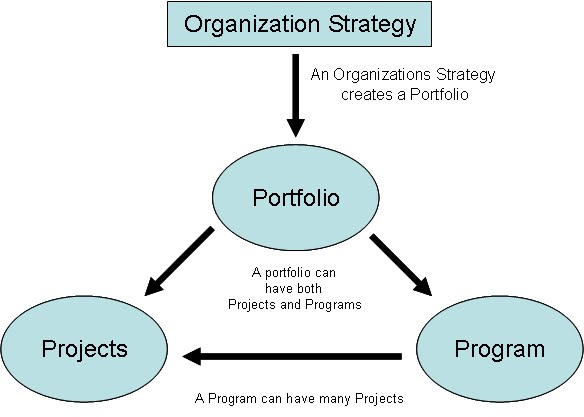
A portfolio contains both programs and projects and is managed by a portfolio manager. The portfolio is drawn directly from the strategic business plan of the organization.
The strategy of an organization is an action plan to achieve its business goals and objectives. It’s also called a strategic plan or a strategic business plan. The strategy determines the portfolio of projects and programs that the organization will execute. A portfolio is a set of projects, programs, or both that is managed in a coordinated fashion to obtain control and benefits not available from managing them individually.

What is Portfolio Management?

Portfolio management is the centralized management of one or more portfolios, and it includes identifying, prioritizing, authorizing, managing, and controlling projects, programs, and other related work in order to obtain specific strategic business objectives of the organization. Just as a program is managed by a program manager, a portfolio is managed by a portfolio manager.
To understand the relationship between these 3 entities, projects, programs and portfolios we need to understand that:

• If an organization does not have any programs but has only individual projects, all these projects can be grouped into one or more portfolios.
• If an organization has programs and no individual project external to all programs, all these programs can be grouped into one or more portfolios.
• If an organization has some programs and some individual projects, all these programs and projects can be grouped into one or more portfolios.

Portfolio management focuses on making sure that programs and projects are prioritized for resources to serve the organization’s strategy. In simpler terms, a portfolio manager worries about the success of the whole strategy put forth by the organization rather than the success of a single project (like what we do)

Therefore, investment decisions are usually made at the portfolio level. Program management focuses on achieving the benefits that would be aligned with the portfolio and hence with the strategic objectives of the organization. So, a portfolio is part of the interface between the programs and strategic business objectives of the organization for which the programs are run.

The relationship between these 3 entities is better explained by the picture below:


As you can see in the picture above, a portfolio is composed of projects, programs or both. And a program consists only of projects.

When compared to projects and programs, a portfolio is closer to an organization’s business objectives, and therefore this is where most of the investment decisions are made.
It’s also important to note that an operation is not part of a project. However, a program can include a non-project work. Similarly, a portfolio can also include work that is not included in any of its constituent projects and programs.

Let us wrap up this chapter with a comparison between projects, programs and portfolios.

Comparison between a Project, a Program, and Portfolio


Previous: Environmental Factors & Process Assets

Next: Other Terms Related to Project Management
© 2013 by www.getpmpcertified.blogspot.com. All rights reserved. No part of this blog or its contents may be reproduced or transmitted in any form or by any means, electronic, mechanical, photocopying, recording, or otherwise, without prior written permission of the Author.

Followers

Popular Posts